Amino acids in pregnancy matter for much more than simply “eating more protein.”
Most pregnancy nutrition conversations stop at protein intake. But protein is not one single nutrient. It is made of amino acids, and each one plays a different role in your baby’s growth, your placenta, your uterus, your blood flow, and your recovery.
Some amino acids that your body can usually make on its own may not be produced fast enough during pregnancy. Researchers call this becoming “conditionally essential.” It means your body’s usual factory settings may no longer be enough, and food has to help meet the extra demand.
This blog looks at four amino acids that deserve more attention during pregnancy: glycine, taurine, arginine and lysine.
We will look at what each one does, why pregnancy changes the need for it, and where to find it, especially in an Indian kitchen.
This is not medical advice. Always speak to your doctor, obstetrician, or qualified nutrition practitioner before changing your diet, protein intake, or supplements during pregnancy.
Why Protein in Pregnancy Is Not the Whole Story
Walk into any pharmacy today and you will find shelves of pregnancy protein powders.
Protein does matter in pregnancy. It supports fetal growth, maternal tissue expansion, placenta development, blood volume, and postpartum recovery.
But the current standard recommendation for protein intake has been questioned by researchers because newer studies using the indicator amino acid oxidation method suggest that protein requirements may be higher than older estimates, especially later in pregnancy. Research led by Elango and colleagues found average protein needs of about 1.2 g/kg/day in early pregnancy and about 1.52 g/kg/day in late pregnancy.
In simple words, your protein needs do not stay flat for nine months.
They rise as pregnancy progresses.
But even that does not tell the full story. The more useful question is not just “How much protein am I eating?” It is also “Am I getting the amino acids my body and baby need most right now?”

What Are Amino Acids?
Amino acids are the building blocks of protein.
When you eat protein-rich foods such as dal, eggs, paneer, curd, fish, chicken, soy, or nuts and seeds, your body breaks that protein down into amino acids. These amino acids are then used to build and repair tissues, support enzymes and hormones, and help your baby grow.
Some amino acids are called essential because your body cannot make them. You have to get them from food.
Some are usually non-essential because your body can make them.
But pregnancy changes the equation.
During pregnancy, demand rises because your body is supporting:
- A growing baby
- A growing placenta
- A larger uterus
- Increased blood volume
- Breast tissue changes
- Connective tissue remodelling
- Postpartum recovery preparation
This is why certain amino acids deserve a closer look.
Which Amino Acids Matter More During Pregnancy?
All amino acids matter, but this blog focuses on four that are especially relevant during pregnancy:
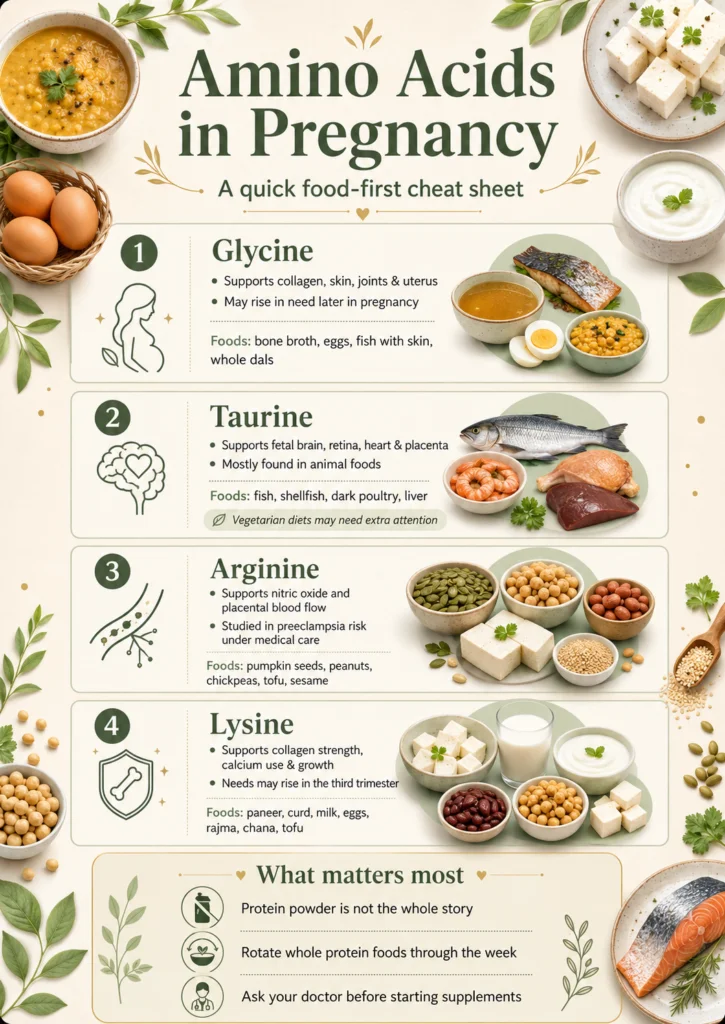
- Glycine
- Taurine
- Arginine
- Lysine
These are not “magic nutrients.” They are not a reason to self-supplement.
They are simply nutrients worth understanding because pregnancy can increase the need for them in specific ways.
Glycine in Pregnancy: The Amino Acid Supporting Collagen and Growth
Glycine is the simplest amino acid, and for most of your life, your body can make it on its own.
Pregnancy changes that.
Glycine is a major building block of collagen, the protein that supports skin, cartilage, tendons, bones, joints, and connective tissue.
During pregnancy, collagen demand rises because your baby’s skeleton, skin, organs, and connective tissues are developing. At the same time, your own uterus is expanding dramatically, and your joints and tissues are adapting to pregnancy.
A study on glycine requirements in pregnancy found that glycine may become conditionally indispensable in late pregnancy, especially when protein intake is at current estimated requirement levels.
Why Glycine Matters in Pregnancy
Glycine may support:
- Collagen formation for the baby’s skin, cartilage, and bones
- Connective tissue remodelling in the uterus and joints
- Maternal tissue repair and recovery
- One-carbon metabolism, a pathway that also involves nutrients like folate and choline
Glycine shortfalls are not always obvious. You may not feel a dramatic symptom. The gap can be biochemical long before it becomes visible.
Food Sources of Glycine
Glycine is found in higher amounts in animal foods that contain skin, bones, and connective tissue.
Good food sources include:
- Bone broth
- Chicken with skin
- Mutton with connective tissue
- Fish with skin
- Eggs
- Slow-cooked dals with skin or husk intact
- Chana dal
- Rajma
- Whole moong
For an Indian plate, slow-cooked dal, whole pulses, eggs, fish, and bone broth where culturally acceptable can all help build a more amino-acid-rich diet.
Unlike many amino acids, taurine is not mainly used to build protein. It is found in high concentrations in tissues like the brain, retina, heart, and placenta.
Taurine in Pregnancy: The Amino Acid Many Vegetarian Diets Miss
Taurine rarely gets discussed in pregnancy nutrition, but it plays an important role in fetal development.
Unlike many amino acids, taurine is not mainly used to build protein. It is found in high concentrations in tissues like the brain, retina, heart, and placenta. A 2022 review described taurine as a maternally derived nutrient involved in mother-to-offspring metabolic support, including transfer through the placenta and breast milk.
The important part is this: taurine is found almost entirely in animal-derived foods.
That makes it a genuine blind spot for vegetarian and vegan pregnancies.
Why Taurine Matters in Pregnancy
Taurine may support:
- Fetal brain development
- Retinal development
- Heart development
- Placental function
- Antioxidant defence
- Fluid and mineral balance inside cells
Human research has also explored taurine in relation to gestational diabetes risk. A 2021 study in Chinese pregnant women found an association between lower plasma taurine levels in early pregnancy and a higher later risk of gestational diabetes.
This does not mean taurine supplements should be started on your own.
It means taurine status is worth discussing with a qualified practitioner, especially if the pregnancy diet is vegetarian, vegan, or very low in animal foods.
Food Sources of Taurine
Taurine is found mainly in animal foods such as:
- Shellfish
- Scallops
- Mussels
- Fish
- Salmon
- Dark poultry meat
- Liver
Vegetarian sources are negligible.
For vegetarian or vegan pregnancies, this is not something to panic about. But it is something to flag with your doctor or nutritionist so your overall protein and micronutrient plan can be built more carefully.
Arginine in Pregnancy: The Amino Acid Supporting Placental Blood Flow
Arginine is important because it helps the body make nitric oxide.
Nitric oxide is a molecule that helps blood vessels relax and widen. During pregnancy, this matters because your blood volume rises and your body has to support healthy blood flow to the placenta.
When this pathway is not working well, blood vessels may stay tighter than they should. This is one mechanism researchers study in relation to preeclampsia and fetal growth restriction.
A 2025 systematic review and meta-analysis on L-arginine and L-citrulline for preeclampsia found that L-arginine may be a promising addition for women at risk, while also noting that more research is needed to understand who benefits most, the best dose, timing, and duration.
This is why arginine is interesting, but also why it should not be treated casually.
Why Arginine Matters in Pregnancy
Arginine may support:
- Nitric oxide production
- Blood vessel relaxation
- Healthy blood flow to the placenta
- Maternal cardiovascular adaptation during pregnancy
- Pregnancy research related to preeclampsia and fetal growth restriction
Arginine supplementation is an active research area. It should only be used under medical supervision, especially in pregnancy.
Food Sources of Arginine
Arginine is one of the more vegetarian-friendly amino acids.
Good food sources include:
- Pumpkin seeds
- Peanuts
- Chickpeas
- Soybeans
- Tofu
- Edamame
- Sesame seeds
- Dairy
- Poultry
- Fish
For an Indian vegetarian plate, chana, peanuts, til, pumpkin seeds, curd, paneer, tofu, and edamame can all help.
Lysine in Pregnancy: The Quiet Structural Amino Acid
Lysine is one of the essential amino acids. This means your body cannot make it at all, so it has to come from food.
During pregnancy, lysine matters because it supports growth, collagen strength, calcium use, and energy metabolism.
Research using amino acid oxidation methods has shown that lysine requirements are higher in late gestation compared with early gestation, which fits with the rapid growth that happens later in pregnancy.
Why Lysine Matters in Pregnancy
Lysine may support:
- Collagen structure and strength
- Calcium utilisation
- Fetal bone growth
- Carnitine production, which helps the body use fat for energy
- Tissue repair and growth
Lysine becomes especially relevant in the third trimester, when fetal growth and bone mineralisation accelerate.
Food Sources of Lysine
Good sources of lysine include:
- Paneer
- Curd
- Milk
- Eggs
- Fish
- Chicken
- Rajma
- Chana
- Soy foods
- Tofu
- Edamame
Vegetarian diets can include lysine, but they need planning. Dairy, dals, legumes, and soy foods become important.
Amino Acids in Pregnancy for Vegetarian and Vegan Diets
Vegetarian pregnancies can absolutely be healthy, but they need more thoughtful planning around protein quality and amino acid variety.
The biggest concern from this list is taurine, because it is almost absent from plant foods.
Glycine and lysine may also need attention, especially if the diet is low in dairy, eggs, soy, whole pulses, or varied protein sources.
Vegetarian Protein Sources to Rotate
A practical Indian vegetarian pregnancy plate can include:
- Moong dal
- Chana dal
- Rajma
- Chole
- Paneer
- Curd
- Milk
- Tofu
- Edamame
- Soy chunks, if tolerated
- Pumpkin seeds
- Peanuts
- Sesame seeds
- Almonds
- Whole moong
- Sprouts, if safely prepared
The goal is not to depend on one protein source every day.
The goal is rotation.
Different foods bring different amino acid profiles.
Is Protein Powder Enough During Pregnancy?
Protein powder can be useful in some cases, especially when appetite is low, nausea is high, or protein intake is genuinely difficult to meet through food.
But protein powder is not the whole story.
A scoop of protein powder may increase total protein intake, but it may not reliably cover glycine, taurine, arginine and lysine in the same balanced way that whole foods can.
Whole foods also bring cofactors like B vitamins, minerals, fats, choline, iron, zinc, and calcium, depending on the food.
That said, protein powders are not automatically bad. The question is whether they are safe, clean, appropriate for pregnancy, and used as a supplement to food rather than a replacement for meals.
Always check with your doctor or nutritionist before using protein powder during pregnancy.
Do You Need Amino Acid Supplements During Pregnancy?
Not automatically.
For most women, the first step is a varied, protein-rich diet built around whole foods.
Amino acid supplements during pregnancy should not be self-prescribed. This is especially important for targeted supplements like L-arginine or taurine, where research may be promising in specific contexts but not appropriate for everyone.
Supplements can be concentrated. They can interact with medical conditions, medications, blood pressure, blood sugar, or pregnancy risk factors.
Food-first is usually the safer place to begin.
What Does This Mean for Your Plate?
This is not about adding four new supplements to your bedside table.
It is about recognising that pregnancy nutrition is more nuanced than “just eat more protein.”
A practical way to think about amino acids in pregnancy is:
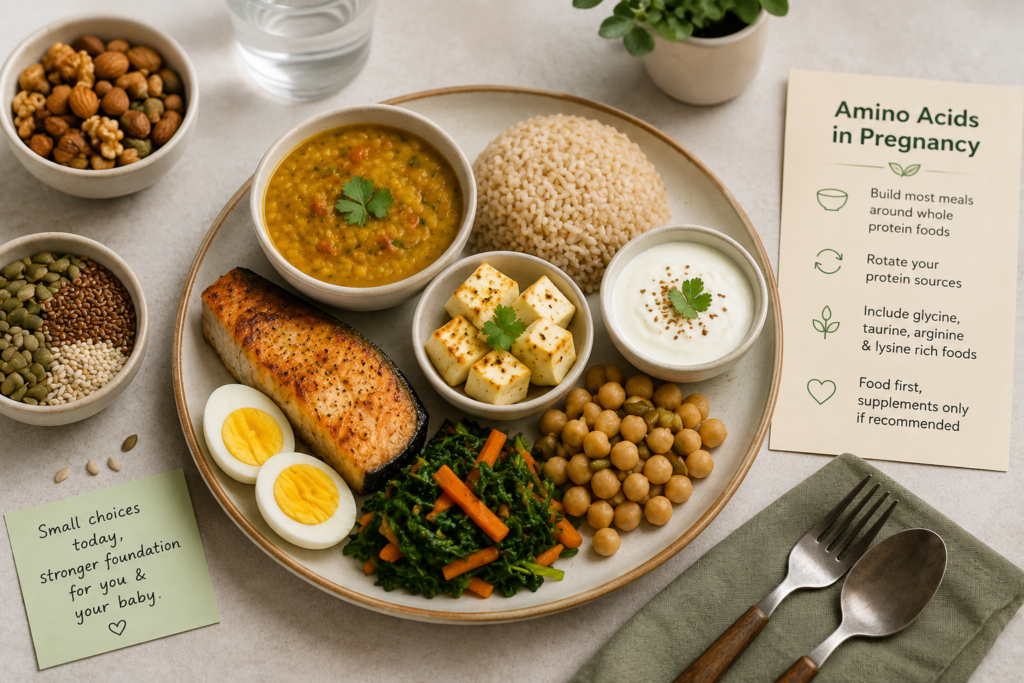
Build Most Meals Around a Whole Protein Source
Choose from:
- Eggs
- Dal with skin or husk intact
- Paneer
- Curd
- Fish
- Chicken
- Tofu
- Chana
- Rajma
- Soy foods
Add Glycine-Rich Foods Where Possible
If you eat non-vegetarian food, include:
- Bone broth
- Fish with skin
- Chicken with skin
- Slow-cooked meats with connective tissue
If you are vegetarian, include more whole pulses, dals with skin, and collagen-supportive nutrients through a well-planned diet.
Pay Attention to Taurine if Vegetarian or Vegan
Since taurine is nearly absent from plant foods, vegetarian and vegan pregnancies should discuss this with a practitioner.
Do not assume a multivitamin covers it.
Keep Arginine Foods in Rotation
Add:
- Pumpkin seeds
- Peanuts
- Chana
- Soybeans
- Tofu
- Edamame
- Sesame seeds
Support Lysine Through Dairy, Eggs, Legumes, or Soy
Good options include:
- Paneer
- Curd
- Milk
- Eggs
- Rajma
- Chana
- Tofu
- Edamame
- Fish or chicken, if non-vegetarian
The Bottom Line
Amino acids in pregnancy deserve more attention than they usually get.
Protein matters, but pregnancy is not just about hitting a protein number. It is about giving your body the right building blocks at the right time.
Glycine supports collagen and connective tissue. Taurine supports fetal tissues like the brain, retina and heart. Arginine supports nitric oxide and blood flow. Lysine supports growth, collagen strength, calcium use, and energy metabolism.
You do not need to become anxious or start supplements on your own.
You need a thoughtful, food-first pregnancy nutrition plan that respects what your body is building.
Start with whole protein foods. Rotate your sources. Pay extra attention if you are vegetarian or vegan. And always speak to your doctor or qualified practitioner before starting any supplement during pregnancy.
FAQs
Why are amino acids important in pregnancy?
Amino acids are the building blocks of protein. During pregnancy, they support fetal growth, placenta development, maternal tissue expansion, blood volume, connective tissue changes, and recovery.
Which amino acids are important during pregnancy?
All amino acids matter, but glycine, taurine, arginine, and lysine are especially worth understanding because their roles become more relevant during fetal growth, placental development, blood flow, and tissue remodelling.
Do protein needs increase during pregnancy?
Yes. Protein needs increase as pregnancy progresses. Research using newer methods suggests that protein requirements may be higher in late pregnancy than older standard estimates.
Is glycine important in pregnancy?
Yes. Glycine supports collagen formation, connective tissue remodelling, and fetal growth. Research suggests glycine may become conditionally indispensable in late pregnancy.
Is taurine important during pregnancy?
Taurine is involved in fetal tissues such as the brain, retina, heart, and placenta. It is mostly found in animal foods, which makes it a nutrient worth discussing in vegetarian or vegan pregnancies.
Can vegetarians get enough amino acids during pregnancy?
Vegetarians can meet many amino acid needs with careful planning through dal, dairy, soy, legumes, nuts, seeds, and whole pulses. Taurine is the clearest concern because it is almost absent from plant foods.
Is protein powder safe during pregnancy?
Protein powder is not automatically unsafe, but it should be checked for quality, ingredients, additives, and pregnancy suitability. It should not replace whole protein foods unless a doctor or nutritionist recommends it.
Do I need amino acid supplements during pregnancy?
Not necessarily. Most needs should first be addressed through a varied whole-food diet. Amino acid supplements, especially targeted ones like L-arginine, should only be used under medical supervision.
Can arginine help prevent preeclampsia?
Research suggests L-arginine may be helpful in some high-risk pregnancies, but evidence is still evolving. It should only be considered with medical guidance and monitoring.
What are the best food sources of amino acids in pregnancy?
Good sources include eggs, dairy, dal, chana, rajma, tofu, edamame, fish, chicken, pumpkin seeds, peanuts, sesame seeds, and whole pulses.