
Meal plan strategies for busy professionals need to be practical, flexible, and realistic enough to survive actual workweeks.
Busy schedules often make healthy eating feel like a challenge. Long work hours, frequent meetings, travel, unpredictable routines, and late evenings can quickly lead to skipped meals, processed snacks, takeout, and energy crashes.
But the key to eating well is not following a perfect diet.
It is creating a meal planning system that is simple, sustainable, and easy to repeat.
These seven meal plan strategies can help busy professionals improve energy, productivity, gut health, and overall wellbeing while making healthy eating fit more naturally into everyday life.
Why Busy Professionals Struggle With Healthy Eating
Most busy professionals do not struggle because they lack discipline.
They struggle because their food plan does not match their life.
A rigid diet chart may look good on paper, but it often falls apart when meetings run late, travel gets added, sleep suffers, or lunch gets pushed to 4 PM.
That is why sustainable meal planning is not about perfection. It is about building a system that still works on imperfect days.
1. Plan Your Meals Around Your Schedule, Not Your Appetite
Many professionals eat only when they feel hungry.
This often leads to skipped meals, overeating later in the day, cravings, and poor food choices.
Instead of deciding what to eat at the last minute, spend a few minutes each week planning your meals around your actual schedule.
Look at:
- Meetings
- Commute time
- Travel days
- Workouts
- Early mornings
- Late evenings
- Social commitments
Then decide where your meals realistically fit.
How to Do This Practically
If you know Monday is packed with meetings, do not plan a complicated lunch.
Pack a simple tiffin or keep a backup meal ready.
If you know you have a late evening call, plan an evening snack so you do not reach dinner starving.
If you travel often, keep portable snacks like roasted chana, nuts, fruit, or protein options ready.
The goal is to plan for the life you actually have, not the ideal day you wish you had.
2. Build Every Meal Using the 4-Part Formula
Rather than counting calories or following a restrictive diet, focus on building balanced meals.
Every main meal should ideally include four parts:
High-Quality Protein
Protein helps with satiety, muscle maintenance, blood sugar stability, and recovery.
Examples include:
- Dal
- Eggs
- Paneer
- Curd
- Tofu
- Chicken
- Fish
- Edamame
- Lentils
- Chickpeas
Fibre-Rich Vegetables
Vegetables add fibre, minerals, antioxidants, and volume to the meal.
Examples include:
- Leafy greens
- Zucchini
- Carrots
- Beans
- Capsicum
- Cucumber
- Broccoli
- Bottle gourd
- Seasonal vegetables
Healthy Fats
Healthy fats support satiety, hormones, and nutrient absorption.
Examples include:
- Avocado
- Nuts
- Seeds
- Ghee
- Coconut
- Olive oil
- Fatty fish
Complex Carbohydrates
Carbohydrates give energy, especially for active professionals or those with long workdays.
Examples include:
- Rice
- Millets
- Roti
- Sweet potato
- Quinoa
- Poha
- Oats
This 4-part formula can make healthy eating easier than calorie tracking because it focuses on structure, not restriction.
3. Follow the 80:20 Rule, Not the Perfect Diet
Healthy eating does not mean every meal has to be perfect.
The 80:20 rule means making nutrient-dense, whole-food choices around 80% of the time, while keeping flexibility for the remaining 20%.
This makes healthy eating more sustainable.
It also reduces the feeling of constantly being “on a diet.”
What the 80:20 Rule Looks Like
It might look like:
- Home-cooked meals through the week and dinner out on Saturday
- A balanced breakfast and lunch, with a flexible evening snack
- Eating clean most days, without guilt over one dessert
- Choosing better meals most of the time, without expecting perfection
The goal is consistency, not control.
A plan that allows flexibility is usually easier to follow long term than a plan that collapses the moment life gets busy.
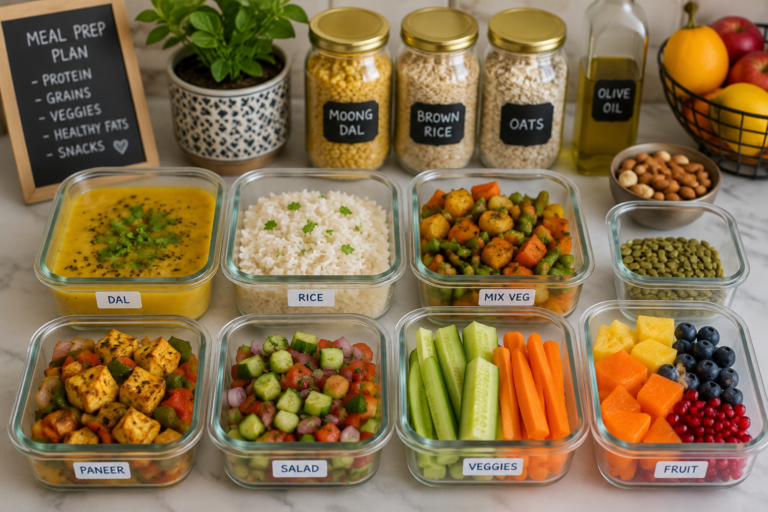
Instead of preparing full meals every day, prepare ingredients that can be mixed and matched through the week.
4. Use Batch Preparation to Save Time
Meal planning does not mean cooking every meal from scratch.
For busy professionals, batch preparation is one of the most useful tools.
Instead of preparing full meals every day, prepare ingredients that can be mixed and matched through the week.
Easy Batch Preparation Ideas
You can:
- Prepare onion-tomato gravies in advance
- Make basic tadkas for quick dals or sabzis
- Marinate chicken or fish ahead of time
- Grill or bake proteins and refrigerate them
- Wash and chop vegetables for quick cooking
- Prepare homemade chutneys and dressings
- Cook rice, millet, or quinoa in larger batches
- Boil eggs in advance
- Keep roasted chana, nuts, or makhana ready
Having these components ready allows healthy meals to come together in just a few minutes.
It also reduces the chance of ordering food because you are too tired to start from zero.
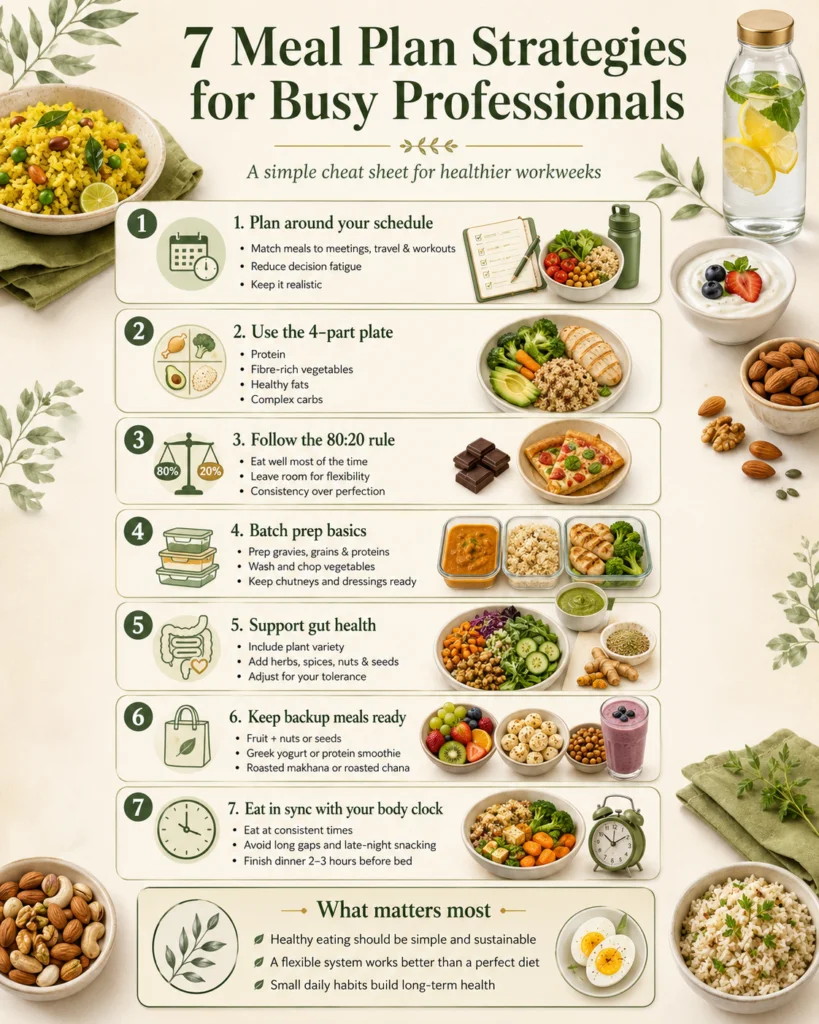
5. Plan Meals That Support Your Gut Health
A healthy meal plan should nourish your gut microbiome, not just fill your stomach.
Your gut health is influenced by the variety, quality, and tolerance of the foods you eat.
Aim to include a wide variety of:
- Vegetables
- Fruits
- Herbs
- Spices
- Nuts
- Seeds
- Legumes, if tolerated
- Fermented foods, if tolerated
These foods provide fibre, prebiotics, polyphenols, and other compounds that support beneficial gut bacteria.
Individual Tolerance Matters
Gut health is not the same for everyone.
Some people feel better with more legumes and dairy. Others may need to temporarily reduce foods like gluten, dairy, soy, pulses, added sugar, or certain high-FODMAP foods depending on their symptoms and tolerance.
This should ideally be done with guidance, especially if you have chronic bloating, IBS, acidity, constipation, loose stools, or food sensitivities.
A gut health meal plan should support your body, not force foods that make you feel worse.
6. Keep Healthy Backup Meals Ready
Busy days are inevitable.
Skipping meals or relying on convenience foods does not have to be.
The easiest way to stay consistent is to keep a few healthy backup meals and snacks ready.
Healthy Backup Options for Busy Days
Keep options like:
- Plant protein shake with almond milk
- Roasted makhana with mixed nuts
- Nut butter with cucumber and carrot sticks
- Fresh fruit with nuts or seeds
- Greek yogurt with berries, if tolerated
- Boiled eggs
- Paneer cubes
- Chana salad
- Coconut water with coconut chunks
- Homemade laddoos
- Leftover dal and rice
These options help prevent long gaps, energy crashes, and last-minute processed snacking.
Backup meals are not a failure of planning.
They are part of the plan.
7. Align Your Meals With Your Body Clock
Meal timing can influence energy, digestion, cravings, and blood sugar regulation.
This is where chrononutrition becomes useful. Chrononutrition looks at how meal timing interacts with the body’s natural circadian rhythm.
You do not need to make this complicated.
Simple Meal Timing Habits
Start with:
- Eating meals at consistent times
- Avoiding frequent meal skipping
- Finishing dinner 2–3 hours before bedtime
- Limiting late-night snacking
- Eating more balanced meals earlier in the day
- Avoiding very long gaps between meals
For busy professionals, this can make a noticeable difference in afternoon energy, cravings, sleep, and digestion.
Eating in sync with your body does not mean following rigid rules. It simply means giving your body a more predictable rhythm.
Sample Meal Plan for Busy Professionals
This is a sample structure, not a fixed diet chart. It can be adjusted based on your health goals, lab results, digestion, food preferences, and schedule.
Meal One: After Waking Up
Options:
- 6–7 soaked almonds
- 1 tbsp ghee or coconut oil, if suitable for you
Meal Two: Breakfast
Options:
- Rice poha with well-cooked vegetables
- Vegetable omelette
Meal Three: Mid-Morning
Options:
- Any whole fruit with coconut chunks
- Coconut water with coconut chunks
Meal Four: Lunch
Options:
- Chicken curry with well-cooked vegetables and rice
- Edamame curry with well-cooked vegetables and rice
Meal Five: Evening Snack
Options:
- Greek yogurt with pistachio, if tolerated
- Protein smoothie
Meal Six: Dinner
Options:
- Grilled salmon with sweet potato and vegetables
- Quinoa with well-cooked vegetables
Water Intake
Aim to drink around 2.5–3 litres of water through the day, unless your doctor has advised a different intake because of kidney, heart, pregnancy, or other medical conditions.
How to Make This Meal Plan Sustainable
A meal plan becomes sustainable when it is simple enough to repeat.
Before starting, ask yourself:
- Can I cook this on a busy weekday?
- Can I carry this to work?
- Can I order a similar version outside?
- Can I prep part of this in advance?
- Does this match my digestion and appetite?
- Will I still follow this after one stressful week?
If the answer is no, simplify the plan.
Healthy eating should reduce stress, not add another layer of pressure.
The Bottom Line
Healthy eating for busy professionals does not have to be complicated.
It simply needs to be sustainable.
By planning around your schedule, building balanced meals, supporting gut health, preparing ingredients in advance, keeping backup options ready, and following a flexible 80:20 approach, you can make nutritious eating fit into even the busiest routine.
Small, consistent habits practiced every day are far more effective than short-term perfection.
You do not need a perfect diet.
You need a system that helps you feel energised, steady, and supported through real life.

FAQs
What are the best meal plan strategies for busy professionals?
The best meal plan strategies for busy professionals include planning meals around your schedule, using batch preparation, building balanced meals with protein and fibre, keeping backup snacks ready, and following the 80:20 rule for flexibility.
How can busy professionals eat healthy every day?
Busy professionals can eat healthy by preparing basic staples in advance, keeping simple snacks available, choosing balanced meals, and avoiding long gaps between meals that lead to cravings or overeating.
What should every meal include?
Every main meal should ideally include protein, fibre-rich vegetables, healthy fats, and complex carbohydrates. This supports energy, satiety, blood sugar balance, and better consistency.
Is meal prep necessary for busy professionals?
Meal prep is not mandatory, but it helps. Even prepping one protein, one grain, and one vegetable base can make healthy eating much easier through a busy week.
What are healthy snacks for busy professionals?
Healthy snacks include roasted makhana, mixed nuts, fruit with seeds, Greek yogurt, boiled eggs, roasted chana, nut butter with vegetables, or a protein smoothie.
How does gut health fit into meal planning?
Gut health fits into meal planning through fibre, plant diversity, herbs, spices, prebiotic foods, and foods that suit your tolerance. A gut-friendly plan should be personalised, especially if you have bloating, IBS, acidity, or constipation.
What is the 80:20 rule in healthy eating?
The 80:20 rule means eating nutrient-dense, balanced meals around 80% of the time while allowing flexibility around 20% of the time. It helps make healthy eating more sustainable.
What is a good dinner time for busy professionals?
A good dinner time is one that allows you to finish eating about 2–3 hours before bedtime. This may support better digestion, sleep, and energy the next day.
How much water should busy professionals drink daily?
Many people do well with around 2.5–3 litres of water per day, but individual needs vary based on activity, climate, health status, pregnancy, and medical conditions.
Why do meal plans fail for busy professionals?
Meal plans often fail because they are too rigid, too complicated, or not built around the person’s actual schedule. A good plan should be flexible enough to survive meetings, travel, stress, and late workdays.