One of the biggest mistakes we make in women’s health is waiting for disease before paying attention.
Most women do not suddenly wake up with PCOS, Hashimoto’s, infertility, severe fatigue or metabolic dysfunction. The body usually gives clues long before a diagnosis appears. The challenge is that many of those clues are easy to miss, especially when routine blood work is limited or interpreted only through the lens of disease, rather than optimal health.
I have spoken to countless women who were told their reports looked “normal” while they were struggling with hair loss, brain fog, stubborn weight gain, irregular periods, fertility concerns, fatigue or worsening PMS. They knew something was not right, yet the answers never seemed to show up on paper.
That is why there are a few blood tests every woman should know about. Not because they are trendy, but because they often reveal what is happening beneath the surface long before the body starts asking for urgent attention.
Why Routine Blood Work May Not Be Enough
Most basic health checkups look for disease. They are designed to identify what is clearly outside the normal range.
But many women experience symptoms long before their reports become obviously abnormal.
A woman may have “normal” haemoglobin but low iron stores. She may have “normal” fasting glucose but rising insulin. She may have “normal” TSH but positive thyroid antibodies. She may have low vitamin D for years without connecting it to fatigue, mood changes, immunity or hormone health.
This is why women’s health needs a more layered approach. The goal is not to over-test or create fear. The goal is to listen earlier.
Ferritin: Your Stored Iron
One of the first markers I look at is ferritin.
Most women know their haemoglobin. Very few know their ferritin.
Ferritin reflects your stored iron, and it can become depleted years before anaemia develops. By the time haemoglobin starts falling, many women have already been experiencing symptoms for quite some time.
Low ferritin can contribute to:
- Fatigue
- Poor exercise recovery
- Hair loss
- Dizziness
- Restless legs
- Brain fog
- Low stamina
- Fertility challenges
Ferritin is particularly important in women with heavy periods, endometriosis, digestive issues or Hashimoto’s.
Iron is not simply about preventing anaemia. It is required for oxygen delivery, thyroid hormone production, energy generation and healthy ovulation. When ferritin is low, the entire system can feel the impact.
Fasting Insulin: The Marker Many Women Miss
Another marker I wish every woman understood is fasting insulin.
In my opinion, fasting insulin deserves far more attention than it gets.
Most women know their fasting glucose. Some know their HbA1c. Yet insulin resistance often develops years before either of those markers becomes abnormal.
During that phase, blood sugar may appear perfectly normal while insulin is quietly climbing higher and higher to keep it there.
This matters because insulin is not just a blood sugar hormone. It directly influences ovulation, testosterone production, inflammation, fat storage and fertility.
I have seen countless women with PCOS, stubborn belly fat, sugar cravings, fatigue after meals and irregular cycles whose glucose looked normal but whose insulin told a very different story.
Many women do not realise they have a blood sugar problem because they do not yet have a blood sugar problem.
They have an insulin problem that is slowly becoming a blood sugar problem.
HbA1c: Your Blood Sugar Pattern Over Time
HbA1c is another important marker because it gives a broader picture of blood sugar patterns over the past few months.
While fasting glucose captures one moment in time, HbA1c helps show how your body has been managing blood sugar more consistently.
For women dealing with PCOS, weight gain, sugar cravings, fatigue, fertility concerns or a family history of diabetes, HbA1c can be useful. But it should not be looked at alone.
Fasting glucose, fasting insulin and HbA1c together give a much clearer picture of metabolic health than glucose alone.
Vitamin D: More Than Bone Health
Then there is vitamin D, one of the most overlooked nutrients in women’s health.
Most people still associate vitamin D only with bone health, but its influence extends far beyond that. Vitamin D receptors are found throughout the body, including the immune system, ovaries, thyroid gland and brain.
Low vitamin D levels have been associated with concerns related to fertility, autoimmune health, insulin resistance, immune function and mood.
Vitamin D is not a miracle nutrient, but it is one of those foundational pieces that can influence multiple systems at the same time. When levels are low, it is often a sign that the body may not be functioning as optimally as it could.
For Indian women, including those living in sunny places, low vitamin D is still very common. This is why it deserves attention instead of being dismissed as a small deficiency.
TSH is useful, but it is only one part of the picture. Free T4 and Free T3 help us understand thyroid hormone availability more clearly.
Thyroid Markers: TSH, Free T4 and Free T3
Many women have had their TSH checked. But thyroid health is not always fully understood through TSH alone.
TSH is useful, but it is only one part of the picture. Free T4 and Free T3 help us understand thyroid hormone availability more clearly.
This matters because thyroid health influences metabolism, mood, energy, hair growth, menstrual cycles, ovulation and fertility.
A woman may be struggling with fatigue, weight gain, constipation, hair fall, low mood or irregular periods, and still be told her thyroid is “normal” because only TSH was checked.
That is why a more complete thyroid panel can be helpful, especially when symptoms are present.
Thyroid Antibodies: The Underappreciated Clue
Finally, there are thyroid antibodies, perhaps one of the most underappreciated tests in women’s health.
Many women have had their TSH checked. Some have had Free T4 measured. But very few have had thyroid antibodies evaluated.
This matters because Hashimoto’s, the most common autoimmune thyroid condition, can develop for years before thyroid hormones become obviously abnormal.
During that time, women may experience fatigue, hair loss, fertility struggles, mood changes, brain fog and weight gain while repeatedly being told their thyroid is “normal.”
Sometimes, antibodies are the earliest clue that the immune system has already started targeting the thyroid.
For this reason, I often think of thyroid antibodies as an immune marker just as much as a thyroid marker.
The Foundational Blood Tests Every Woman Should Know About
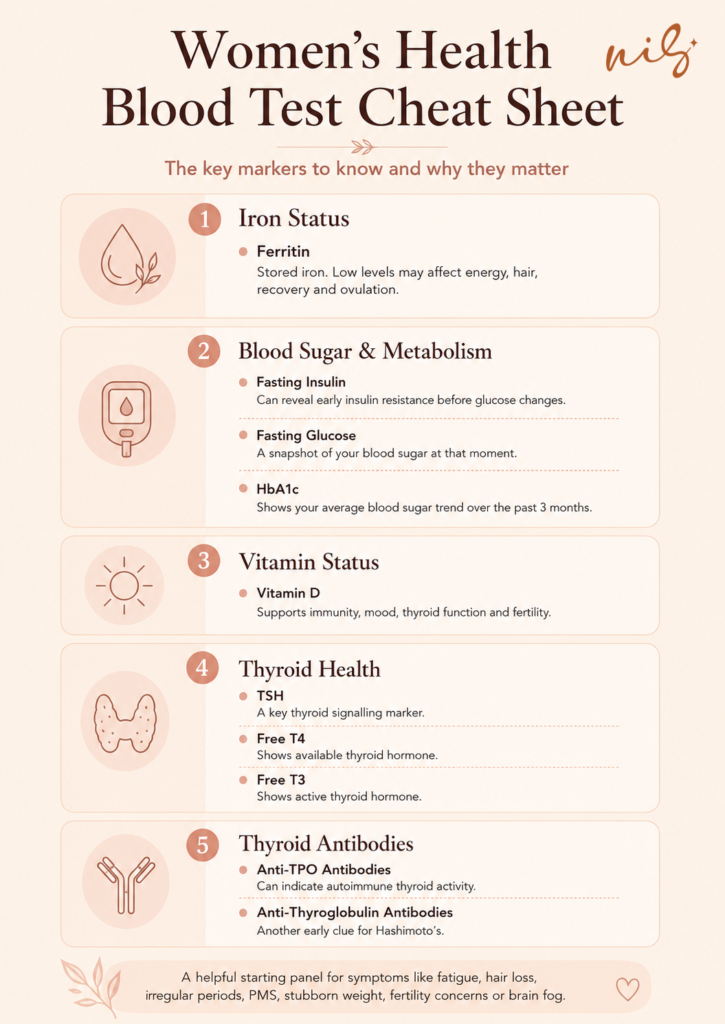
If I had to build a simple foundational female health panel, it would include:
- Ferritin
- Fasting insulin
- Fasting glucose
- HbA1c
- Vitamin D
- TSH
- Free T4
- Free T3
- Anti-TPO antibodies
- Anti-Thyroglobulin antibodies
Not because every woman will have a problem.
But because these markers often help identify dysfunction before it becomes disease.
And that is where the real opportunity lies.
Why These Markers Often Overlap
What fascinates me is how often these findings overlap.
The woman with low ferritin may also have Hashimoto’s.
The woman with insulin resistance may also have low vitamin D.
The woman struggling with fertility may have all three.
This is why women’s health cannot be reduced to a single hormone, a single nutrient or a single diagnosis.
The body operates as an interconnected system. Your metabolism influences your hormones. Your thyroid influences your fertility. Your nutrient status influences your energy. Your immune system influences all of them.
At Nutrition In Sync, our ONE Program helps women understand these root connections through personalised nutrition, bloodwork insights and hormone-smart lifestyle support, so symptoms are not treated in isolation.
Because by the time the body starts screaming, the process has usually been unfolding for years.
The goal is not to wait for something to be wrong enough.
The goal is to listen while the body is still whispering.

FAQs
What are the most important blood tests for women?
Some of the most important blood tests for women include ferritin, fasting insulin, fasting glucose, HbA1c, vitamin D, TSH, Free T4, Free T3, Anti-TPO antibodies and Anti-Thyroglobulin antibodies.
Why is ferritin important for women?
Ferritin reflects stored iron. Low ferritin can contribute to fatigue, hair loss, dizziness, poor recovery, brain fog and fertility challenges, even when haemoglobin is still normal.
Why should women check fasting insulin?
Fasting insulin can reveal early insulin resistance before fasting glucose or HbA1c becomes abnormal. This is especially important for women with PCOS, stubborn weight, cravings, irregular periods or fertility concerns.
Are thyroid antibodies necessary if TSH is normal?
In some women, yes. Thyroid antibodies can indicate autoimmune thyroid activity, such as Hashimoto’s, before TSH becomes clearly abnormal. This can be important when symptoms like fatigue, hair loss, fertility struggles or brain fog are present.
How often should women get these blood tests done?
This depends on symptoms, medical history, age and health goals. Many women benefit from checking foundational markers yearly, while those with PCOS, thyroid concerns, heavy periods, fertility plans or chronic symptoms may need more personalised guidance.