
When we think about fertility, most of us immediately think about estrogen, progesterone, ovulation and timing intercourse correctly.
Rarely do we think about insulin.
And yet, insulin may be one of the most important fertility hormones nobody is talking about.
Over the years, we have learned that fertility is not simply a reproductive health conversation. It is also a metabolic health conversation. Your ovaries do not function in isolation. They are constantly receiving information about what is happening elsewhere in the body, and one of the strongest signals they receive every day is information about your metabolic health.
This is where insulin resistance and fertility become deeply connected.

What Does Insulin Have to Do With Fertility?
Most of us know insulin as the hormone responsible for regulating blood sugar.
But insulin does far more than that.
Your ovaries contain insulin receptors, which means they are constantly responding to insulin’s message. When insulin resistance develops, the body compensates by producing more insulin. For years, blood sugar levels may remain completely normal because the pancreas is working overtime to keep them there.
On paper, everything can look fine.
Meanwhile, elevated insulin may be quietly influencing inflammation, fat storage, testosterone production and ovulation.
This is why many women do not realise they have a metabolic issue. They may not yet have a blood sugar problem. They may have an insulin problem that is slowly becoming a blood sugar problem.
Insulin Resistance, PCOS and Ovulation
This is one reason we see such a strong connection between insulin resistance and PCOS.
Elevated insulin can stimulate the ovaries to produce more androgens, including testosterone. This can disrupt ovulation, affect cycle regularity and alter the hormonal environment needed for conception.
For some women, this shows up clearly as irregular periods, acne, facial hair growth, stubborn belly fat, cravings or difficulty losing weight.
For others, it is quieter.
Their cycles may seem somewhat regular, but they still struggle with poor egg quality, delayed ovulation, recurrent pregnancy loss or unexplained fertility challenges.
This is why fertility conversations need to include more than estrogen and progesterone. We also need to talk about fasting insulin, blood sugar stability and the metabolic environment surrounding the ovaries.
Ovulation Is Important, But It Is Not the Whole Story
One of the biggest misconceptions in fertility is that if you are ovulating, everything must be fine.
Ovulation is important, but fertility is not simply about releasing an egg.
It is also about releasing a healthy egg.
And that is where insulin resistance becomes even more relevant.
When we talk about egg quality, age tends to dominate the conversation. To be clear, the biological clock is real. As women age, both egg quantity and egg quality naturally decline.
But age is not the entire fertility story.
If it were, every woman of the same age would have the same fertility experience. That is clearly not what we see.
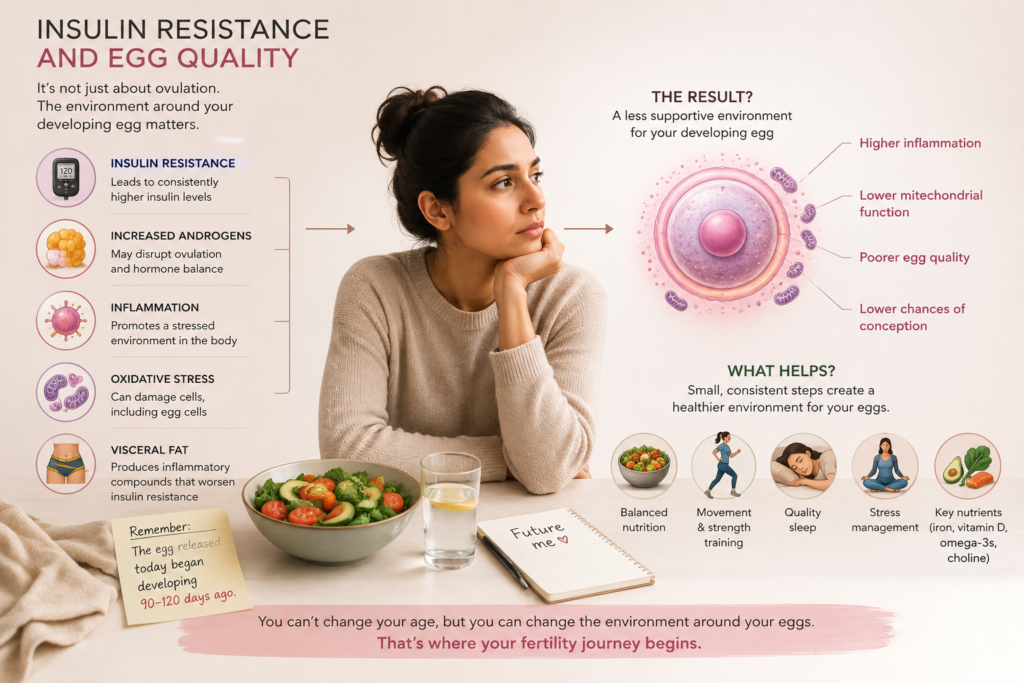
Every developing egg exists within a biochemical environment. That environment is shaped by inflammation, nutrient status, oxidative stress, mitochondrial health and blood sugar regulation.
In many ways, your eggs are a reflection of the environment they are developing in.
Every egg contains thousands of mitochondria, tiny energy-producing structures responsible for powering fertilisation, chromosome separation and early embryo development.
How Insulin Resistance May Affect Egg Quality
Insulin resistance does not only affect blood sugar. It can also promote inflammation and oxidative stress throughout the body.
Developing eggs are not separate from that environment.
Every egg contains thousands of mitochondria, tiny energy-producing structures responsible for powering fertilisation, chromosome separation and early embryo development. These mitochondria are sensitive to inflammation, nutrient deficiencies and oxidative stress.
The healthier those mitochondria are, the better equipped an egg is to do its job.
This is why fertility specialists and nutritionists are paying increasing attention to metabolic health long before conception occurs.
Fertility is not simply a reproductive issue.
It is also a metabolic one.

Visceral Fat, Inflammation and Fertility
One of the strongest drivers of insulin resistance is excess visceral fat, the fat stored deep around the organs.
Unlike the fat sitting beneath the skin, visceral fat is metabolically active. It releases inflammatory compounds that can worsen insulin resistance and increase oxidative stress throughout the body.
A cycle begins to emerge.
Insulin resistance promotes fat storage.
Fat storage promotes inflammation.
Inflammation worsens insulin resistance.
And the environment surrounding the developing egg becomes progressively less supportive.
This is why fertility cannot be reduced to a number on the scale.
We have seen women in smaller bodies struggling with significant insulin resistance and women in larger bodies with surprisingly healthy metabolic markers.
The real question is not simply what you weigh.
It is what is happening metabolically beneath the surface.
What Should Women Check Before Trying to Conceive?
If you are tracking ovulation but still struggling to conceive, it may be worth looking beyond reproductive hormones alone.
Helpful markers to discuss with a qualified practitioner may include:
- Fasting insulin
- Fasting glucose
- HbA1c
- Ferritin
- Vitamin D
- Thyroid markers
- Thyroid antibodies
- Inflammation markers, when relevant
We also need to talk about nutrient deficiencies, particularly iron, vitamin D, omega-3 fats and choline.
We need to talk about gut health, because poor digestion can affect inflammation, immune function and nutrient absorption.
We need to talk about sleep, because even a few nights of poor sleep can reduce insulin sensitivity.
And we need to talk about muscle, because muscle is one of the most powerful tools we have for improving insulin sensitivity and supporting metabolic health.
Why Fertility Preparation Starts Months Before Pregnancy
Perhaps the most empowering thing to understand is that the egg released this month did not begin developing this month.
Its journey started approximately 90 to 120 days ago.
That means the meals you are eating today, the sleep you are getting tonight, the muscle you are building in the gym and the blood sugar stability you are creating now may influence the eggs you ovulate months from today.
Fertility preparation does not begin only when you are ready for a baby.
It begins when you are ready to create a healthier environment for your future eggs.
At Nutrition In Sync, our ONE Program helps women understand these root connections through personalised nutrition, bloodwork insights and hormone-smart lifestyle support, so fertility is supported as part of the whole body, not treated as one isolated symptom.
Because while we cannot change our age, we can influence the environment surrounding our eggs.
And that is a fertility conversation far more women deserve to hear.
FAQs
Can insulin resistance affect fertility?
Yes. Insulin resistance can affect fertility by influencing ovulation, androgen levels, inflammation, egg quality and hormone balance. This is especially common in PCOS, but it can also happen without a formal PCOS diagnosis.
Can blood sugar be normal but insulin still be high?
Yes. In early insulin resistance, blood sugar may still look normal because the body produces more insulin to keep it stable. This is why fasting insulin can sometimes reveal metabolic stress before fasting glucose or HbA1c changes.
How does insulin resistance affect egg quality?
Insulin resistance may increase inflammation and oxidative stress, which can affect the environment where eggs mature. Since eggs rely heavily on mitochondrial energy, metabolic health can play an important role in egg quality.
What are signs of insulin resistance in women?
Common signs may include sugar cravings, fatigue after meals, stubborn belly fat, difficulty losing weight, acne, facial hair growth, irregular periods, brain fog and worsening PMS.
How long before trying to conceive should I work on insulin resistance?
Ideally, women should begin supporting metabolic health at least three to four months before trying to conceive, because the egg ovulated today has been developing for roughly 90 to 120 days.