
Understanding free vs total hormones can help explain why two women with similar hormone blood test results may have very different experiences.
You get your bloodwork back.
Testosterone: normal.
Oestrogen: normal.
But you’re exhausted. Your cycle is irregular. Your hair is thinning. And nothing about how you feel seems to match the word normal sitting next to your results.
It’s frustrating, particularly when you’ve been looking for an explanation.
Sometimes, the answer lies in something your standard hormone panel hasn’t fully assessed: the difference between total hormone levels, free hormones and the proteins that carry them through your bloodstream.
But it is important to remember that not every unexplained symptom is caused by a hidden hormone imbalance.
The real goal is to understand what your blood tests measure, what they don’t, and when looking further might actually help.
What Is the Difference Between Free and Total Hormones?
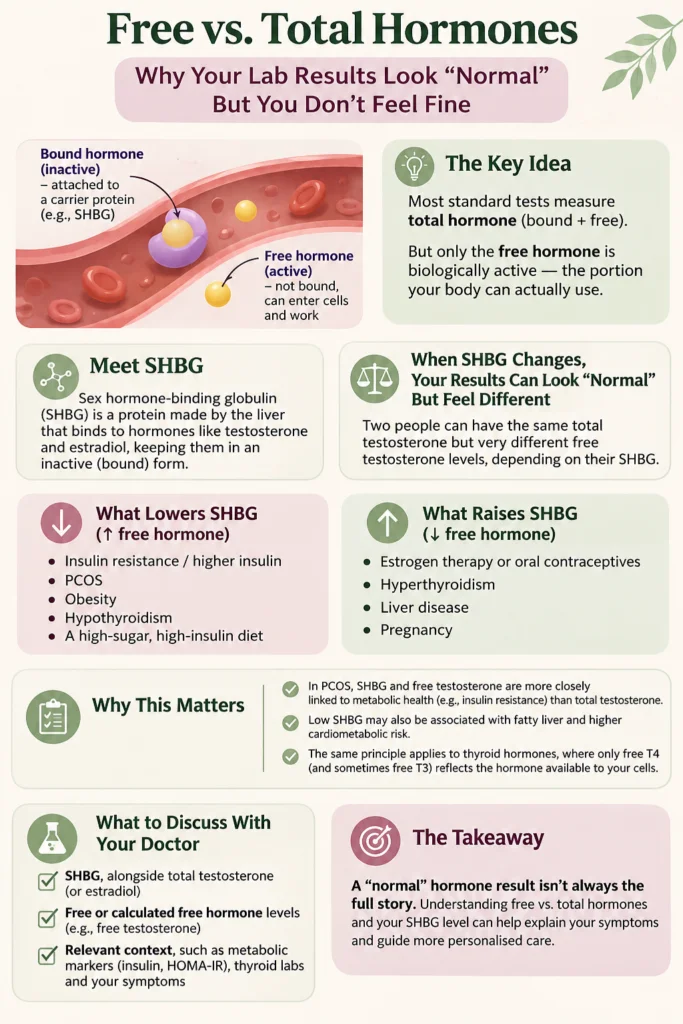
Hormones travel through your bloodstream in different forms.
Some circulate freely, while others attach to proteins that transport them through the blood.
Think of these binding proteins as carriers.
The amount of hormone circulating in your blood is not necessarily the same as the amount available to interact with your body’s tissues.

What Are Total Hormones?
Total hormone levels generally include both protein-bound and unbound hormone circulating in the blood.
For example, total testosterone includes testosterone attached to carrier proteins as well as the small amount circulating freely.
Total testosterone is an important clinical measurement, but its interpretation may be affected by changes in hormone-binding proteins.
What Are Free Hormones?
Free hormones are the fraction circulating without being attached to a binding protein.
This fraction is available to interact with tissues.
For testosterone, only approximately 1–2% normally circulates freely. Most is bound to sex hormone-binding globulin (SHBG) or albumin.
However, the distinction isn’t simply that bound hormone is inactive and free hormone is useful.
Hormones bound loosely to albumin may also be biologically available, and binding proteins can influence hormone transport and regulation.
This is why hormone interpretation can be more complicated than one number.
Can Total Testosterone Be Normal While Free Testosterone Is Abnormal?
Yes.
A woman may have total testosterone within the laboratory reference range but an unusually high or low free testosterone concentration.
One reason is variation in SHBG.
When SHBG levels are higher, a greater proportion of circulating testosterone is tightly bound.
When SHBG levels are lower, the free fraction of testosterone may increase.
This distinction is particularly relevant when investigating androgen-related symptoms, including excess facial hair, acne and certain features of PCOS.
It doesn’t mean every woman with fatigue or hair thinning has an abnormal free testosterone level.
It means that in the right clinical circumstances, total testosterone alone may not provide enough information.
What Is SHBG and Why Does It Matter for Hormone Health?
SHBG stands for sex hormone-binding globulin.
It is a protein produced primarily by the liver that binds to sex hormones, especially testosterone and oestradiol.
SHBG helps regulate how much hormone circulates in tightly bound form.
How Does SHBG Affect Free Testosterone?
Imagine two women with the same total testosterone result.
One has relatively high SHBG.
The other has relatively low SHBG.
Even though their total testosterone values are similar, the amount circulating freely may differ.
This is why SHBG can be useful when interpreting testosterone results.
What Causes Low SHBG Levels?
Several factors are associated with lower SHBG, including:
Insulin resistance
Higher circulating insulin levels
PCOS
Obesity
Hypothyroidism
Certain metabolic and hormonal conditions
Low SHBG can increase the proportion of free testosterone, depending on total testosterone and other factors.
However, SHBG alone cannot diagnose insulin resistance or PCOS.
What Causes High SHBG Levels?
SHBG may increase in association with:
Pregnancy
Oestrogen-containing oral contraceptives
Oestrogen therapy
Hyperthyroidism
Certain liver conditions
The reason for an abnormal SHBG result matters as much as the result itself.
Why Is SHBG Important in PCOS?
PCOS is one of the conditions where the distinction between free and total testosterone becomes particularly important.
Many women with PCOS have increased androgen activity, which can contribute to symptoms such as:
Irregular periods
Acne
Excess facial or body hair
Scalp hair thinning
Ovulatory dysfunction
Insulin resistance and higher insulin levels may contribute to lower SHBG.
When SHBG is reduced, the proportion of circulating free testosterone may increase.
This can contribute to androgen-related symptoms even when total testosterone isn’t markedly elevated.
Which Testosterone Tests Are Recommended for PCOS?
The 2023 International Evidence-based Guideline for PCOS recommends assessing total and free testosterone when investigating biochemical hyperandrogenism.
Free testosterone can be calculated using appropriate measurements or assessed using specialised laboratory methods.
The accuracy of the testing method matters.
A healthcare professional may request:
Total testosterone
SHBG
Calculated free testosterone or free androgen index
Additional androgen tests where indicated
Women taking combined oral contraceptives may have altered SHBG and androgen levels, making results more difficult to interpret.
Medication changes should only be considered with medical guidance.
Can SHBG Reveal Insulin Resistance or Metabolic Problems?
SHBG is also associated with metabolic health.
Lower SHBG concentrations have been observed in some people with insulin resistance, obesity, PCOS and metabolic dysfunction.
Research has also explored associations between low SHBG and metabolic conditions such as fatty liver disease.
However, these are associations rather than proof of a particular diagnosis.
A low SHBG result doesn’t automatically mean you have insulin resistance, and normal SHBG doesn’t rule it out.
What Other Tests May Be Needed?
Depending on symptoms and medical history, your doctor may consider:
Fasting glucose
HbA1c
A 75 g oral glucose tolerance test
Lipid profile
Thyroid function tests
Other metabolic investigations
The purpose is to understand the broader clinical picture rather than relying on SHBG as a standalone metabolic marker.
Free vs Total Thyroid Hormones: Does the Same Principle Apply?
Yes, although thyroid testing follows different diagnostic principles from sex hormone testing.
Thyroid hormones circulate in both protein-bound and free forms.
The main thyroid hormones are T4, or thyroxine, and T3, or triiodothyronine.
Most circulating thyroid hormone is bound to transport proteins, including thyroxine-binding globulin (TBG), transthyretin and albumin.
Only a small fraction circulates freely.
What Is the Difference Between Free T4 and Total T4?
Total T4 measures both bound and free thyroxine.
Free T4 measures the unbound fraction.
If thyroid-binding protein concentrations change, total T4 can increase or decrease without a corresponding change in thyroid function.
For example, pregnancy and oestrogen-containing medications may increase TBG.
This can raise total thyroid hormone measurements even when thyroid function remains normal.
Why Is TSH Usually the First Thyroid Test?
TSH, or thyroid-stimulating hormone, is produced by the pituitary gland.
It helps regulate thyroid hormone production.
For most people with an intact pituitary-thyroid system, TSH is the preferred initial screening test for thyroid dysfunction.
If TSH is abnormal, free T4 can help determine whether hypothyroidism or hyperthyroidism is present.
Free T4 may also be required when pituitary disease is suspected or in other specific clinical situations.
Do You Need Free T3 Testing Too?
Not routinely.
Free T3 or total T3 testing can be useful in selected cases, particularly when hyperthyroidism is suspected.
However, T3 testing is generally less useful for diagnosing hypothyroidism.
More thyroid tests do not automatically mean a more accurate diagnosis.
The right tests depend on the clinical question.
Why Can Hormone Tests Be Normal When You Still Have Symptoms?
Hormone-related symptoms can overlap with many other health conditions.
For example, fatigue, hair thinning, irregular cycles and changes in weight can have several potential explanations.
These may include:
Thyroid dysfunction
PCOS
Iron deficiency
Vitamin B12 deficiency
Sleep disturbances
Nutritional inadequacy
Stress
Medication effects
Other reproductive or metabolic conditions
Sometimes hormone-binding proteins affect how a result should be interpreted.
Sometimes the hormone results genuinely are normal, and the explanation lies elsewhere.
Both possibilities deserve consideration.
This is why a good clinical assessment should connect symptoms, relevant test results, medications, menstrual history and lifestyle rather than focusing on a single hormone number.
What Hormone Tests Should You Discuss With Your Doctor?
If your hormone blood tests appear normal but symptoms persist, the most useful next step is a focused conversation with your healthcare provider.
For Acne, Excess Hair Growth or Irregular Periods
Your doctor may consider investigating androgen excess or PCOS using appropriate testosterone measurements, SHBG and other tests.
For Fatigue, Cold Intolerance or Thyroid Symptoms
TSH is usually the starting point, with free T4 added when indicated.
For Irregular Menstrual Cycles
Testing may depend on your age, pregnancy possibility, medication use, symptoms and menstrual history.
The appropriate evaluation can include reproductive hormones or tests for other causes of cycle irregularity.
For Metabolic Concerns
Blood glucose, HbA1c, lipids and other investigations may be more useful than ordering an extensive hormone panel.
The goal isn’t to test everything.
It’s to test what is relevant.
How to Interpret Hormone Lab Results More Effectively
Hormone test results become more meaningful when interpreted alongside context.
1. Understand What Was Actually Measured
Was the test measuring total testosterone, free testosterone, total T4 or free T4?
These are different measurements.
2. Check the Testing Method
Some hormone measurements, particularly testosterone testing in women, require sensitive laboratory methods.
The test’s accuracy matters.
3. Consider Medication Use
Oral contraceptives, hormone therapy, thyroid medication and other treatments can affect hormone concentrations or binding proteins.
4. Consider Timing
Some reproductive hormones fluctuate throughout the menstrual cycle.
A result may need to be interpreted according to cycle timing, age and reproductive stage.
5. Connect the Result With Symptoms
One normal or abnormal result rarely explains everything.
Clinical history and symptom patterns remain essential.
6. Avoid Treating Numbers in Isolation
An isolated hormone measurement is not a reason to start supplements, hormone therapy or medication.
Treatment decisions should be based on a clinically established need.
The Bottom Line: Normal Hormone Results Don’t Always Tell the Whole Story
A laboratory result can be accurate and still require context.
Total testosterone doesn’t always tell you the same thing as free testosterone.
SHBG can influence how testosterone results are interpreted.
And thyroid-binding proteins can affect total thyroid hormone levels without necessarily changing thyroid function.
But this doesn’t mean every normal hormone result is hiding a problem.
It means understanding what was tested and why matters.
If your blood tests keep coming back normal but you’re still experiencing persistent symptoms, the answer isn’t necessarily more testing.
It’s a more thoughtful conversation about your symptoms, clinical history, and which investigations would genuinely help.
Because your lab report is one part of your health story.
Not the whole story.

Frequently Asked Questions
What is the difference between free and total hormones?
Total hormone measurements generally include both protein-bound and unbound hormone, while free hormone refers to the fraction circulating without binding to carrier proteins. The clinical importance of this difference varies depending on the hormone being tested.
Can free testosterone be abnormal if total testosterone is normal?
Yes. Differences in SHBG and other binding factors can cause free testosterone levels to differ even when total testosterone remains within the reference range.
What is SHBG in a blood test?
SHBG, or sex hormone-binding globulin, is a protein mainly produced by the liver that binds to sex hormones, including testosterone and oestradiol. It helps regulate the amount of hormone circulating in bound and free forms.
Does low SHBG mean I have PCOS?
No. Low SHBG can be associated with PCOS and insulin resistance, but it is not diagnostic on its own. PCOS diagnosis requires a broader clinical assessment.
Can high SHBG cause low free testosterone?
High SHBG can reduce the proportion of testosterone circulating freely. Whether this is clinically important depends on total testosterone, symptoms, medications and other findings.
Is free testosterone more important than total testosterone?
Both can be useful. When investigating androgen excess in women, particularly PCOS, assessing both total and free testosterone can improve diagnostic evaluation.
What is the difference between free T4 and total T4?
Total T4 includes both protein-bound and free thyroxine, while free T4 measures the unbound fraction. Total T4 may change when thyroid-binding proteins change, even without a significant change in thyroid function.
Why did my doctor test TSH but not free T4 or T3?
TSH is usually the preferred first test for thyroid dysfunction. Free T4 is added when indicated, while T3 testing is mainly useful in selected cases of suspected hyperthyroidism.
Can birth control pills affect hormone blood tests?
Yes. Combined oral contraceptives can increase SHBG and suppress androgen production, making testosterone results more difficult to interpret. Never stop prescribed contraception solely for testing without medical guidance.
What should I do if my hormone tests are normal but I still have symptoms?
Discuss your persistent symptoms with your healthcare provider. They can review the tests already performed, medications, menstrual history and other possible causes before deciding whether additional investigations are needed.