
Abstract
HYROX combines running, strength training and repeated high-intensity efforts, making it a demanding test of endurance, strength and recovery. For women, successful HYROX preparation requires more than a structured workout plan. Adequate energy availability, carbohydrate and protein intake, menstrual health, iron status, bone health and recovery all play important roles. Understanding how these factors influence performance can help women prepare for HYROX without compromising hormonal health or long-term wellbeing.
How Does HYROX Training Affect Women’s Health?
HYROX training can improve cardiovascular fitness, muscular strength and endurance. However, when intense training is combined with inadequate nutrition and insufficient recovery, women may experience fatigue, poor performance, menstrual disturbances and an increased risk of injury.
The problem isn’t HYROX itself. It’s the combination of high training demands, under-fuelling and inadequate recovery.
HYROX combines repeated running intervals with functional exercises such as sled pushes, sled pulls, lunges, rowing and carries. This requires the body to produce energy repeatedly, tolerate sustained physical effort and recover between training sessions.
For women preparing for HYROX, energy availability and hormonal health deserve particular attention.
Why Is Energy Availability Important for Women Training for HYROX?
Energy availability refers to the energy remaining for normal physiological functions after accounting for exercise-related energy expenditure.
Your body needs energy not only to complete workouts but also to support:
Reproductive and menstrual function
Hormone production and regulation
Bone maintenance and repair
Immune function
Muscle recovery
Normal metabolic processes
When training intensity increases without a corresponding increase in food intake, energy availability can fall.
This becomes particularly concerning when someone simultaneously tries to:
Lose weight aggressively
Increase running volume
Add heavy strength training
Perform frequent HYROX conditioning sessions
Maintain a restrictive diet
Research in female athletes has linked low energy availability during training overload with impaired ovarian function and poorer training adaptation.
The goal shouldn’t be to see how little you can eat while doing more training. It should be to provide enough energy for your body to adapt.

What Is Relative Energy Deficiency in Sport (REDs)?
Relative Energy Deficiency in Sport, or REDs, is a condition associated with problematic low energy availability over time.
According to the 2023 International Olympic Committee consensus statement, REDs can affect reproductive, metabolic, musculoskeletal, immune and cardiovascular health, along with athletic performance.
Signs of Possible Under-Fuelling in Female Athletes
Persistent fatigue
Declining exercise performance
Poor recovery between workouts
Irregular or missing periods
Recurring illness
Frequent injuries or bone stress injuries
Difficulty tolerating usual training loads
These symptoms can have multiple causes and do not automatically mean someone has REDs. However, persistent symptoms deserve evaluation rather than being dismissed as a normal part of training.
Training harder is not always the solution to poor performance. Sometimes, the body needs more energy and recovery.
HYROX, Cortisol and Hormonal Health: What Women Should Know
Cortisol is often described on social media as a hormone that needs to be kept low.
But cortisol is a normal and essential part of the body’s response to physical activity.
During demanding exercise, cortisol helps mobilise energy and supports the body’s response to physiological stress.
A temporary increase in cortisol during or after exercise is not inherently harmful.
The concern is the broader pattern:
High training stress + inadequate nutrition + psychological stress + insufficient recovery.
When this imbalance continues over time, it can contribute to disruptions in several physiological systems, including reproductive and metabolic function.
Importantly, an isolated cortisol measurement does not reliably tell you whether you’re overtraining or under-fuelling.
Instead of focusing on cortisol alone, assess your nutrition, sleep, training progression, menstrual health and recovery.
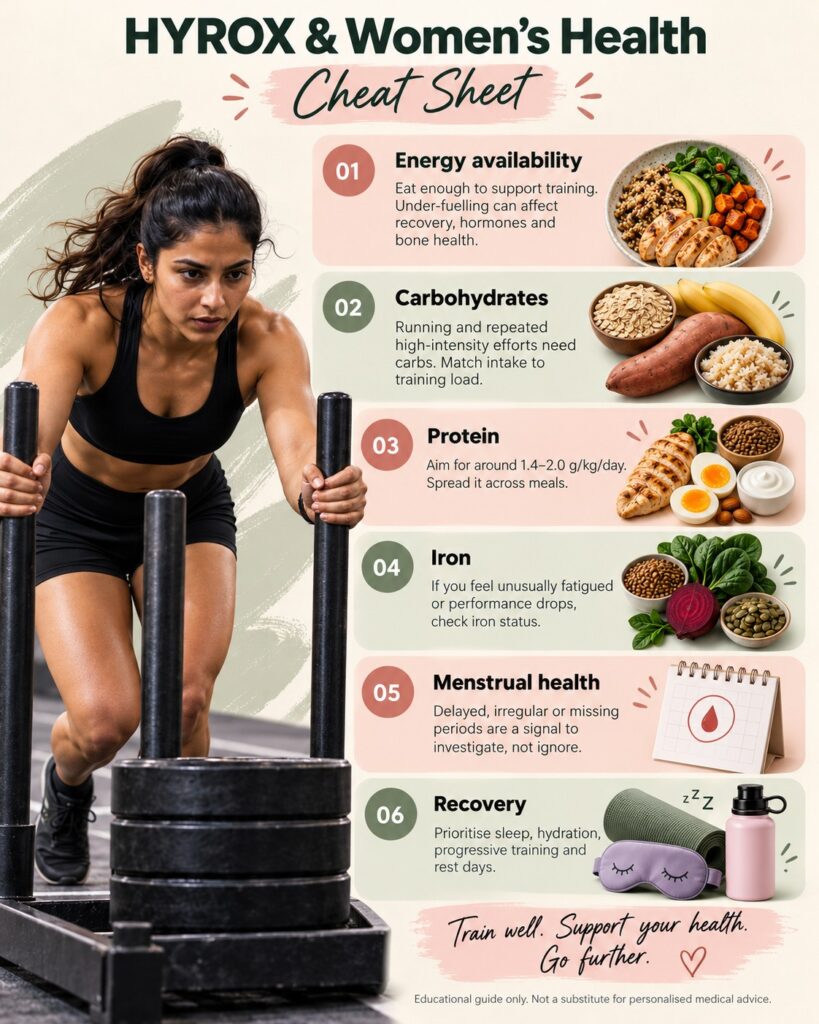
Can HYROX Training Affect Your Menstrual Cycle?
Yes. Intense exercise combined with inadequate energy availability can contribute to menstrual disturbances in some women.
Changes may include:
Longer or irregular menstrual cycles
Delayed periods
Missing periods
Changes in ovulatory function
However, irregular periods are not always caused by exercise. Conditions such as PCOS, thyroid disorders, pregnancy and other medical factors can also affect menstrual health.
Why Menstrual Health Matters for Athletic Performance
Low energy availability can suppress reproductive hormones in some athletes.
Prolonged menstrual dysfunction associated with low oestrogen availability can also negatively affect bone health, increasing the risk of bone stress injuries.
This is particularly important for HYROX athletes because running and repeated lower-body loading place considerable demands on the musculoskeletal system.
A regular menstrual cycle can provide useful information about reproductive health, although it does not rule out low energy availability.
Women using hormonal contraception may not experience the same visible menstrual changes, which makes monitoring other symptoms important.
Your period isn’t an inconvenience that gets in the way of training. It can be an important signal of how your body is responding to its overall demands.
If periods become persistently irregular or stop during HYROX preparation, seek medical assessment rather than assuming it’s simply a sign of hard training.
Why Comparing Your HYROX Fitness to Instagram Can Be Misleading
You might see someone online who runs almost every day, lifts heavy weights, completes demanding conditioning sessions and maintains a lean physique.
It’s easy to think:
“If she can do it, I should be able to do it too.”
But you don’t know her:
Training history
Actual calorie intake
Recovery routine
Menstrual health
Iron status
Previous injuries
Genetics
Years of endurance training
Current fitness level
You’re comparing your starting point to someone else’s highlight reel.
HYROX preparation should be based on your current strength, running capacity, recovery and nutritional needs, not another person’s social media routine.
How to Prepare for HYROX: Nutrition and Recovery Tips for Women
1. Eat Enough to Support Your HYROX Training
As running mileage, resistance training and conditioning increase, energy requirements often increase too.
Aggressive calorie restriction during a demanding training block can interfere with recovery and adaptation.
Adequate energy availability supports muscle repair, hormonal function, bone health and overall training performance.
Instead of focusing only on calories burned, consider whether your food intake is sufficient to support the work you’re asking your body to perform.
2. Prioritise Carbohydrates for HYROX Performance
HYROX involves sustained running and repeated high-intensity efforts, both of which place considerable demands on carbohydrate availability.
Carbohydrates help replenish muscle glycogen, a major fuel source during moderate-to-high-intensity exercise.
Restricting carbohydrates while increasing training volume can compromise workout quality and recovery.
Carbohydrate-rich foods for HYROX training include:
Rice
Oats
Potatoes
Whole grains
Bananas and other fruits
Bread and other easily tolerated carbohydrate sources
For longer or more demanding sessions, carbohydrate intake before, during and after exercise may help support performance and recovery.
The exact amount depends on session intensity, duration, individual tolerance and overall training load.
Think:
More demanding training = greater carbohydrate requirements.
Not:
More demanding training = eat less.
3. Get Enough Protein for Muscle Recovery
Protein supports muscle repair, recovery and adaptation following strength and endurance training.
For many exercising adults, approximately 1.4–2.0 grams of protein per kilogram of body weight per day is a commonly supported range.
Individual requirements can vary depending on training intensity, energy intake and body composition goals.
For example, a woman weighing 60 kg may require approximately 84–120 grams of protein per day within this range.
Protein-rich food sources include:
Eggs
Greek yoghurt and dairy products
Paneer
Tofu and soy products
Lentils and beans
Fish, poultry and lean meats
Protein supplements when convenient
Distributing protein across meals can help support muscle protein synthesis.
However, protein does not replace the carbohydrates needed to fuel demanding exercise.
4. Monitor Iron Levels, Especially During Endurance Training
Iron is particularly important for female athletes because it supports oxygen transport and energy metabolism.
Menstrual blood loss, inadequate dietary intake and exercise-related factors can contribute to iron deficiency.
Low iron stores may affect energy levels and endurance performance, even before anaemia develops.
Symptoms worth evaluating include:
Persistent fatigue
Reduced endurance
Unusual breathlessness
Declining exercise performance
Difficulty recovering from training
Depending on symptoms and risk factors, a healthcare professional may recommend:
Complete Blood Count (CBC)
Serum ferritin
Transferrin saturation
Additional iron studies when appropriate
Iron supplementation should be based on individual assessment rather than guesswork.
5. Protect Bone Health While Increasing Running Volume
HYROX training includes running, lunges, loaded carries and other demanding movements.
Increasing training volume too quickly can raise injury risk, particularly when recovery or energy intake is inadequate.
For women, low energy availability and menstrual dysfunction can further increase concerns about bone health.
Important foundations include:
Adequate energy intake
Sufficient calcium
Appropriate vitamin D status
Progressive training loads
Strength training
Rest and recovery
Persistent, localised bone pain during running should be assessed rather than repeatedly trained through.
6. Hydrate According to Your Training Demands
Hydration needs vary based on exercise duration, sweat rate, environmental conditions and individual physiology.
HYROX training can involve considerable fluid losses, particularly during long conditioning sessions or in hot and humid environments.
Consider:
Fluid intake before training
Hydration during longer sessions
Post-workout fluid replacement
Sodium losses during heavy sweating
For prolonged or particularly sweaty workouts, fluids containing electrolytes may be useful.
However, drinking excessive water without considering individual needs can also be harmful.
Hydration should be planned according to your training conditions and sweat losses rather than following one rigid rule.
7. Use Supplements to Support, Not Replace, Good Nutrition
Some sports supplements have evidence supporting their use in strength and high-intensity exercise.
Creatine monohydrate
Creatine can support strength, power output and performance during repeated high-intensity efforts.
A common maintenance intake is approximately 3–5 grams per day.
Caffeine
Caffeine can improve endurance, alertness and certain aspects of exercise performance when used appropriately.
However, sensitivity varies, and caffeine may worsen anxiety, gastrointestinal symptoms or sleep quality in some individuals.
Neither creatine nor caffeine compensates for inadequate food intake, poor sleep or insufficient recovery.
The fundamentals should always come first.
How Much Recovery Do Women Need During HYROX Training?
Recovery requirements depend on training history, total workload, exercise intensity and individual circumstances.
Rather than copying someone else’s training schedule, build a programme that allows adequate recovery between demanding sessions.
Important recovery practices include:
Consistent sleep, generally around 7–9 hours for most adults
Easier training days between demanding sessions when appropriate
Adequate post-workout nutrition
Gradual increases in running and strength volume
Monitoring persistent fatigue, soreness and performance changes
Adjusting training when injury symptoms develop
Training adaptations happen when the body has sufficient time and resources to recover.
More training is not automatically better training.

HYROX Readiness Checklist for Women
Before registering for a HYROX race, ask yourself:
Can I currently manage the running demands of my training?
Am I recovering adequately between sessions?
Am I eating enough to support my training volume?
Is my menstrual cycle regular, if I menstruate naturally?
Do I experience persistent fatigue or recurring injuries?
Have I considered my iron status if I have symptoms or risk factors?
Am I getting sufficient sleep?
Am I progressing gradually rather than rushing preparation?
Being able to complete one extremely demanding workout doesn’t necessarily mean you’re ready for an entire HYROX training programme.
Frequently Asked Questions About HYROX and Women’s Health
1. Is HYROX good for women’s health?
HYROX training can improve cardiovascular fitness, strength and endurance when approached with appropriate preparation, nutrition and recovery. Problems are more likely when training demands consistently exceed an individual’s capacity to recover or when energy intake is inadequate.
2. Can HYROX training cause hormonal imbalance?
HYROX itself does not automatically cause hormonal imbalance. However, prolonged low energy availability associated with intensive exercise can disrupt reproductive and metabolic functions, particularly when combined with inadequate recovery.
3. What should women eat while training for HYROX?
A HYROX nutrition plan should provide adequate total energy, carbohydrates for training fuel, protein for muscle recovery, dietary fats and essential micronutrients. Individual requirements depend on body weight, training volume and overall health.
4. Can intense HYROX training affect your period?
Intensive training combined with inadequate energy intake can contribute to irregular or missed periods in some women. Persistent menstrual changes should be medically evaluated because several other health conditions can also cause them.
5. How much protein do women need for HYROX?
Many exercising adults benefit from approximately 1.4–2.0 grams of protein per kilogram of body weight per day, although requirements vary. Adequate carbohydrate and total energy intake remain equally important for recovery.
6. How do you prevent overtraining while preparing for HYROX?
Increase training loads progressively, include appropriate recovery days, maintain sufficient energy intake, prioritise sleep and monitor changes in fatigue, performance and injury symptoms. Persistent problems warrant assessment rather than simply pushing harder.
Conclusion: Train for Performance Without Compromising Women’s Health
Women can absolutely train for and compete in HYROX.
But the goal shouldn’t be to become as lean as possible while doing as much training as possible.
It should be to build strength, endurance and resilience while providing the body with enough energy to adapt.
Carbohydrates, protein, iron, hydration, hormonal health and recovery all contribute to sustainable athletic performance.
If your menstrual cycle becomes irregular, your recovery declines or persistent fatigue develops during preparation, don’t automatically treat it as proof of hard work.
It may be a signal that your training, nutrition and recovery need reassessment.
Train for performance, but never at the expense of your long-term health.