
Omega-3 Dosing: Why Fish Oil Labels Can Be Misleading
Omega-3 dosing can feel simple until you actually read a fish oil label.
You pick up a bottle. It says “1000 mg fish oil” in bold letters on the front.
The reasonable assumption is: 1000 mg of omega-3.
Except that is very often not true.
And this one assumption may be one of the biggest reasons people take fish oil for months, sometimes years, without ever reaching a dose that meaningfully matches why they started taking it.
Why “1000 mg Fish Oil” Does Not Mean “1000 mg Omega-3”
Fish oil is not the same thing as omega-3.
Fish oil is the raw oil extracted from fish. It contains omega-3 fatty acids, mainly EPA and DHA, but it can also contain saturated fat, other polyunsaturated fats, and non-active lipid material.
Omega-3 is only a portion of that oil.
Not the whole thing.
So when a label says “1000 mg fish oil,” that number usually refers to the total oil weight, not the active omega-3 content.
A standard 1000 mg fish oil softgel may provide around 300 mg of combined EPA and DHA, sometimes less. NIH supplement label examples commonly show 1000 mg fish oil products providing 180 mg EPA and 120 mg DHA, adding up to 300 mg of actual EPA + DHA.
That means the number on the front of the bottle can be much larger than the omega-3 dose your body is actually getting.

The Number That Actually Matters: EPA + DHA
If you remember one thing, make it this:
Ignore the “fish oil” number on the front.
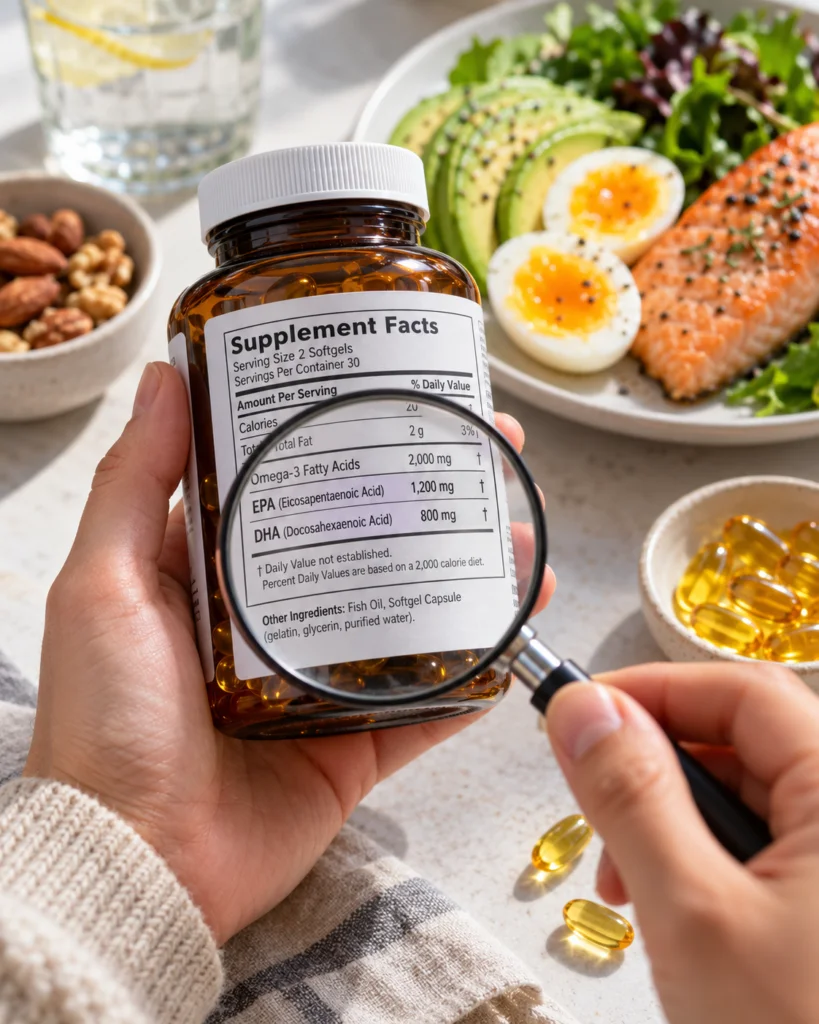
Flip the bottle over and find EPA and DHA on the Supplement Facts panel.
Then add those two numbers together.
That combined figure is your real omega-3 dose.
For example:
EPA: 180 mg
DHA: 120 mg
Total EPA + DHA: 300 mg
That is the number that matters.
Two bottles can both say “1000 mg fish oil” on the front, while one gives 300 mg EPA + DHA and another gives 700 mg EPA + DHA.
Same front label.
Very different supplement.
Why Serving Size Matters on Fish Oil Labels
The next thing to check is serving size.
Sometimes the EPA + DHA number is listed per one capsule.
Sometimes it is listed per two capsules.
Sometimes it may even be listed per three capsules.
So before you calculate your omega-3 dosing, check:
How many capsules make one serving?
How much EPA is in that serving?
How much DHA is in that serving?
How many capsules are you actually taking?
If the label says 600 mg EPA + DHA per serving, but the serving size is two capsules, each capsule gives only 300 mg EPA + DHA.
This is where many people accidentally underdose.
Why EPA and DHA Are Listed Separately
EPA and DHA are the two main long-chain omega-3 fatty acids found in fish oil.
They are both useful, but they are not identical.
EPA is often discussed in relation to inflammation balance, triglycerides, and cardiovascular research.
DHA is especially important for the brain, eyes, pregnancy, fetal development, and cell membranes.
Most people do not need to obsess over the ratio unless they are taking omega-3 for a specific clinical reason.
But they do need to know the combined amount.
That is the dose.
Does the Form of Omega-3 Matter?
Yes. The form can affect absorption.
Omega-3 supplements are commonly sold in different chemical forms, including:
Triglyceride form, or TG
Re-esterified triglyceride form, or rTG
Ethyl ester form, or EE
Free fatty acid form
Triglyceride and re-esterified triglyceride forms are generally considered better absorbed than ethyl ester forms, although ethyl ester forms are still used in some clinical and high-dose products.
The practical point is simple:
If you are taking an ethyl ester form, taking it with food becomes even more important.
Why You Should Take Fish Oil With Food
Omega-3 absorption improves when taken with a meal that contains some fat.
This matters regardless of the supplement form, but it is especially relevant for ethyl ester fish oil, which may absorb less efficiently on an empty stomach.
A practical way to take fish oil:
With breakfast containing eggs, avocado, nuts, curd, or ghee
With lunch containing fish, dal, paneer, olive oil, or nuts
With dinner that includes some healthy fat
Taking fish oil with a meal is one of the easiest ways to make the supplement work harder.
How Much Omega-3 Do You Actually Need?
Omega-3 dosing depends on why you are taking it.
A single “1000 mg fish oil” label cannot answer that question.
General Wellness
For general health, many recommendations commonly fall around 250–500 mg per day of combined EPA + DHA.
This may come through fatty fish intake or a modest supplement, depending on your diet.
Cardiovascular Support
The American Heart Association has historically advised about 1 g/day of EPA + DHA, preferably from oily fish, for people with documented coronary heart disease, with supplements considered in consultation with a physician.
This does not mean everyone should self-prescribe 1 g/day.
It means cardiovascular dosing should be matched to individual risk and medical guidance.
Pregnancy
Pregnancy needs special attention because DHA is important for fetal brain and eye development.
NIH’s omega-3 fact sheet summarizes pregnancy guidance that women of childbearing age and pregnant women consume at least 250 mg/day DHA plus EPA, with an additional 100–200 mg/day of DHA during pregnancy.
This is why prenatal omega-3 products should be checked carefully for actual DHA and EPA amounts, not just “fish oil” weight.
High Triglycerides
For elevated triglycerides, omega-3 doses used clinically are often much higher, usually in the gram range, and should be supervised by a doctor.
This is not the same as taking a regular over-the-counter fish oil capsule.
High-dose omega-3 can interact with medical conditions, medications, bleeding risk, and cardiovascular history.
The FDA also specifies that dietary supplement labels should not recommend more than 2 g/day of combined EPA and DHA without medical guidance.
The standard PMOS advice is often: “Lose 5–10% of your weight.” But for a woman already at a healthy weight, that advice can be harmful.
The Quiet Problem: Fish Oil Freshness and Oxidation
There is one more layer most labels do not make obvious: freshness.
Omega-3 fats are highly unsaturated. That makes them fragile and prone to oxidation when exposed to heat, light, oxygen, and time.
In simpler words, fish oil can go rancid.
The industry uses markers such as:
Peroxide value, or PV
Anisidine value, or AV
TOTOX score, which combines oxidation markers
Lower is better.
A strong “old fish” smell, bitter taste, or paint-like odour can be a clue that the oil may be oxidised.
It is not a perfect test, but it is worth paying attention to.
A good product should not smell aggressively rancid.
Why Third-Party Testing Matters
There is also a less obvious issue: what the label says is not always exactly what is inside.
Third-party testing helps verify:
EPA content
DHA content
Heavy metals
Oxidation levels
Purity
Potency
Contaminants
This matters because omega-3 supplements vary widely in quality.
Look for brands that are transparent about testing, certificates of analysis, or independent quality verification.
This is not about being fancy.
It is about knowing whether the product is fresh, potent, and accurately labelled.
How to Read a Fish Oil Label
Use this checklist in order.
1. Ignore the Front-of-Bottle Fish Oil Number
“1000 mg fish oil” usually means total oil weight.
It does not mean 1000 mg EPA + DHA.
2. Find EPA and DHA
Turn the bottle over and look for:
EPA
DHA
Add them together.
That is the real omega-3 dose per serving.
3. Check the Serving Size
Is the EPA + DHA amount for:
One capsule?
Two capsules?
Three capsules?
Calculate your real dose based on how many capsules you actually take.
4. Check the Form
Look for whether the product is:
TG
rTG
EE
Free fatty acid
If it does not say, you may need to ask the brand.
5. Look for Third-Party Testing
Choose products that test for:
Potency
Oxidation
Heavy metals
Purity
This is the best way to know the label matches the capsule.
6. Take It With a Fat-Containing Meal
Do not take fish oil like a random tablet on an empty stomach.
Take it with food.
Absorption is better, and it may also reduce fishy burps.
Why This Matters More Than It Seems
None of this is about brand-chasing or being a supplement snob.
It is about dose.
Two people can both take “one fish oil capsule a day” for a year and get completely different amounts of EPA and DHA.
One person may be getting 300 mg EPA + DHA in ethyl ester form on an empty stomach.
Another may be getting 600 mg EPA + DHA in triglyceride form with breakfast.
Same habit.
Very different outcome.
If you are taking fish oil for general wellness, pregnancy, cardiovascular support, inflammation balance, or triglyceride management, it is worth spending two minutes with the bottle in hand.
Flip it over.
Find EPA.
Find DHA.
Add them together.
That is your real dose.

The Bottom Line
Omega-3 dosing is not about the biggest number on the front of the bottle.
It is about the EPA and DHA on the back.
A 1000 mg fish oil capsule may only contain a fraction of that as actual omega-3.
To choose better, check EPA + DHA, serving size, supplement form, third-party testing, freshness, and whether you are taking it with food.
Your supplement is only useful if your body is actually getting what you think it is getting.
FAQs
Is 1000 mg fish oil the same as 1000 mg omega-3?
No. The 1000 mg number usually refers to total fish oil, not actual omega-3 content. The real omega-3 dose is the combined EPA + DHA listed on the Supplement Facts panel.
What should I check first on a fish oil label?
Check EPA and DHA first. Add them together to calculate the real omega-3 dose per serving.
How much EPA and DHA should I take daily?
It depends on your goal. General wellness may use lower doses, while cardiovascular support, pregnancy, or high triglycerides may require different amounts. Higher doses should be discussed with a healthcare provider.
Is ethyl ester fish oil bad?
Not necessarily. Ethyl ester fish oil is used in many products, including some clinical formulations. However, it may be less efficiently absorbed than triglyceride forms, especially if taken without food.
Should I take fish oil with food?
Yes. Fish oil is best taken with a meal that contains some fat because this can improve omega-3 absorption and may reduce fishy burps.
How do I know if fish oil is rancid?
A strong old fish smell, bitter taste, or paint-like odour may suggest oxidation. Third-party testing for PV, AV, and TOTOX values is more reliable.
What is EPA?
EPA stands for eicosapentaenoic acid. It is one of the main omega-3 fatty acids found in fish oil and is often studied for inflammation balance, triglycerides, and cardiovascular health.
What is DHA?
DHA stands for docosahexaenoic acid. It is an omega-3 fatty acid important for the brain, eyes, pregnancy, fetal development, and cell membranes.
What is the best form of omega-3 supplement?
Triglyceride and re-esterified triglyceride forms are generally considered better absorbed than ethyl ester forms, though the best choice depends on dose, purpose, product quality, and practitioner guidance.
Do I need third-party tested fish oil?
It is strongly preferable. Third-party testing helps verify potency, freshness, oxidation levels, purity, and whether the EPA and DHA amounts match the label.