Lean PMOS: Why You Can Have PMOS at a Normal Weight
Lean PMOS means you can have PMOS at a perfectly normal weight.
And because your body does not fit the usual picture people associate with PMOS, your symptoms may be dismissed for years.
Irregular periods. Jawline acne. Facial hair. Hair thinning. Fertility concerns. Sugar cravings. Mood changes. A body that looks “fine” from the outside, but feels like something is off from the inside.
Nothing about your body is failing.
It may simply have been asked the wrong questions for years.
What Is Lean PMOS?
Lean PMOS refers to PMOS in women who are not overweight or obese.
These women may have a normal BMI, but still experience hormonal symptoms such as irregular cycles, acne, excess facial or body hair, hair fall, ovulation issues, or difficulty conceiving.
This is why weight alone should never be used to rule PMOS in or out.
A woman can be slim and still have disrupted ovulation, higher androgens, insulin issues, inflammation, or altered hormone signalling.

The Decade You Weren’t Imagining
Maybe you were seventeen when your periods first went quiet for three months.
Someone said it was exam stress.
At twenty-two, the acne moved to your jawline and stayed.
At twenty-six, you noticed hair growing where it had not before. So you started managing it privately, the way most women do.
Every time you brought it up, someone looked at you kindly and said the same thing:
“You’re slim. It’s probably nothing.”
You were handed a birth control pill, which worked beautifully, until you came off it at thirty-two, hoping to start a family, and everything came back at once.
Now someone finally says the word PMOS, and your first feeling is not shock.
It is grief for the fifteen years nobody looked.
If any part of that feels familiar, please stay with us.
There is a real explanation, and it is kinder than the one you have been carrying.
Why Lean PMOS Is Often Missed
Lean PMOS is often missed because many people still associate PMOS with visible weight gain.
For years, the “typical” PMOS patient was understood through the lens of women who reached specialist clinics. Women carrying more weight were often referred sooner, investigated more thoroughly, and taken more seriously.
Slim women, on the other hand, were often reassured, tested lightly, and sent home.
So the “typical PMOS patient” was never the full biological truth.
She was simply the woman the system was looking at.
That left many normal-weight women with PMOS symptoms feeling unseen.
Can You Have PMOS Without Weight Gain?
Yes. You can have PMOS without weight gain.
Weight gain is common in PMOS, but it is not required for diagnosis. PMOS is a hormonal and metabolic condition, and the way it shows up can vary widely from woman to woman.
Some women experience more visible metabolic symptoms. Others experience cycle irregularity, acne, hair growth, fertility issues, or hormone disruption without obvious weight changes.
This is why a normal weight should not end the conversation.
It should simply change the questions being asked.
What Is Happening Inside Lean PMOS?
This is the part that often brings women enormous relief, because it finally explains the gap between how they look and how they feel.
Insulin Resistance Can Happen at a Normal Weight
Insulin resistance does not require extra weight.
Some lean women with PMOS may still have impaired insulin sensitivity, even when fasting glucose, fasting insulin, or basic markers look normal.
Extra weight can worsen insulin resistance, but it does not always create it.
This matters because a woman can look slim and still experience symptoms linked to blood sugar and insulin patterns, such as:
- Sugar cravings
- Energy crashes
- Stubborn belly fat
- Acne flares
- Irregular ovulation
- Fatigue after meals
Body Composition May Be Different
A woman with lean PMOS may have a normal BMI but still have differences in body composition.
This can include lower muscle mass, a higher body fat percentage, or more fat stored around the abdomen or organs, even if she does not look visibly overweight.
This is why BMI alone can be misleading.
Muscle, fat distribution, waist measurement, strength, activity, and metabolic markers often tell a much better story than weight alone.
Hormone Signalling Can Be Disrupted
For many slim women, the story may begin with hormone signalling.
The hypothalamus, pituitary gland, and ovaries communicate through a rhythm of hormonal signals. In PMOS, this signalling can become disrupted.
This may affect ovulation, androgen levels, cycle regularity, skin, hair growth, and fertility.
That is why a woman can have clearly disrupted symptoms even when her weight and some metabolic markers look normal.
Why Even the Blood Tests May Miss Lean PMOS
The tests most commonly ordered, such as fasting insulin or HOMA-IR, may not always capture what is happening in lean women.
A lean woman can show normal fasting insulin and still have an exaggerated insulin response after a glucose load.
This means she may be handed a “normal” report while her body is still struggling with blood sugar and insulin dynamics.
The standard PMOS advice is often: “Lose 5–10% of your weight.” But for a woman already at a healthy weight, that advice can be harmful.
Which Tests May Be More Useful in Lean PMOS?
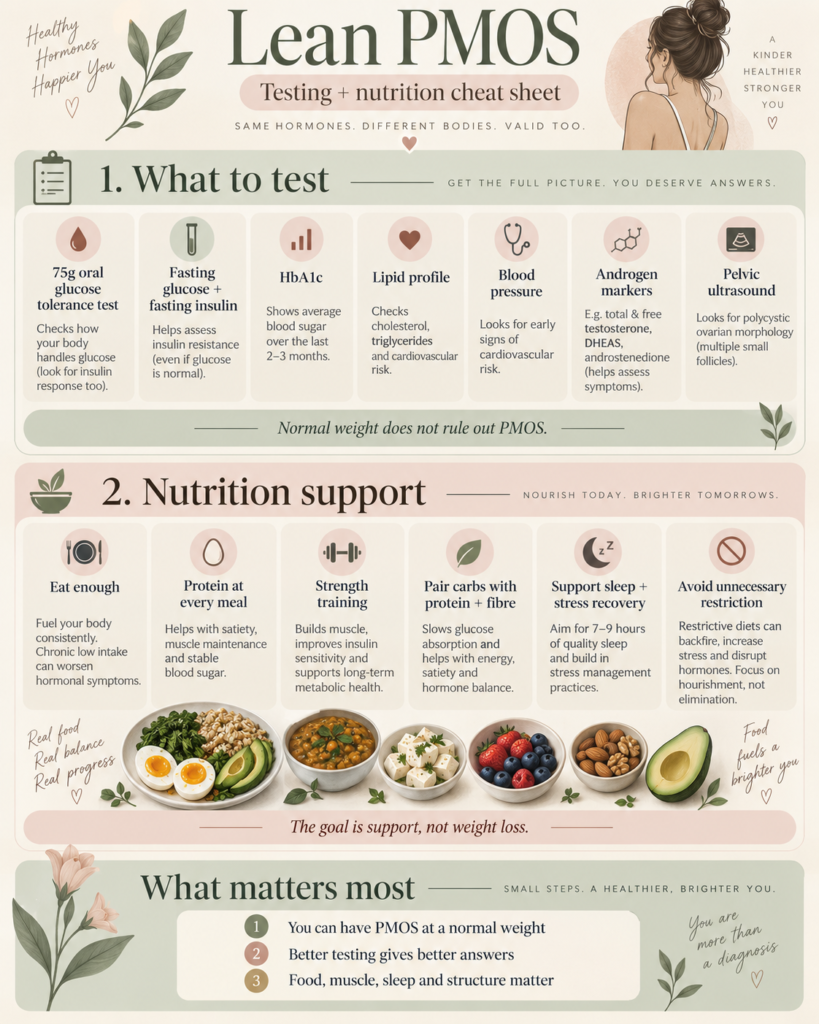
For women with suspected lean PMOS, it may be worth discussing a more complete assessment with a healthcare provider.
This may include:
- 75g oral glucose tolerance test
- Fasting glucose
- Fasting insulin
- HbA1c
- Lipid profile
- Blood pressure
- Androgen markers
- AMH, if clinically relevant
- Pelvic ultrasound, where indicated
- Cycle history and ovulation tracking
The 75g oral glucose tolerance test is often considered more sensitive for glucose health in PMOS than fasting markers alone, especially when symptoms and history suggest a deeper pattern.
You are allowed to ask for better testing.
Please do.
Why Standard PMOS Advice May Not Fit Lean PMOS
The standard PMOS advice is often: “Lose 5–10% of your weight.”
But for a woman already at a healthy weight, that advice can be harmful.
It may quietly push her toward under-eating, over-exercising, and chronic stress.
And those can disturb hormones even more.
Many women with lean PMOS have spent years dieting their hormones into deeper silence, believing they were doing everything right.
In lean PMOS, the goal is usually not weight loss.
The goal is hormone support, blood sugar stability, ovulation support, muscle building, stress regulation, and nourishment.
What Actually Helps Lean PMOS?
What helps lean PMOS often looks like the opposite of restriction.
Eat Enough
Under-eating can worsen stress hormones, disturb ovulation, reduce thyroid conversion, affect sleep, and increase cravings.
Lean PMOS care should begin with enough food, not less food.
Anchor Every Meal With Protein
Protein supports blood sugar balance, satiety, muscle repair, and hormone health.
Good options include:
- Eggs
- Paneer
- Curd
- Dal
- Chana
- Rajma
- Tofu
- Edamame
- Fish
- Chicken
- Nuts and seeds
Build Muscle Through Strength Training
Muscle is one of the most insulin-sensitive tissues in the body.
For lean women with PMOS, building muscle can be more helpful than simply doing more cardio.
Strength training may support:
- Insulin sensitivity
- Body composition
- Energy
- Metabolism
- Cycle health
- Long-term metabolic resilience
Support Blood Sugar Without Cutting All Carbs
Lean PMOS does not mean carbohydrates are the enemy.
It means carbohydrates may need structure.
Pair carbs with protein, fibre, and fats. Choose slower carbohydrates more often. Avoid long gaps between meals that lead to cravings or energy crashes.
Examples include:
- Rice with dal and sabzi
- Millet roti with paneer or eggs
- Sweet potato with omelette
- Fruit with nuts or curd
- Poha with vegetables and protein
Protect Sleep and Stress Recovery
Stress is not “just in your head.”
Chronic stress can affect blood sugar, ovulation, cortisol, inflammation, cravings, and cycle rhythm.
For lean PMOS, nervous system care is not optional soft advice.
It is part of the plan.
This can include:
- Consistent sleep timing
- Fewer skipped meals
- Strength training without overtraining
- Breathwork or yoga
- Morning light exposure
- Lower caffeine dependence
- Recovery days
Don’t Let Anyone Frighten You
Lean PMOS deserves attention, but it does not need panic.
The evidence around long-term risks in lean PMOS is more mixed than the fear-based internet often suggests.
The right approach is thoughtful screening, regular monitoring, and support that fits your actual body.
Not fear.
Not dismissal.
Not unnecessary restriction.
What to Ask Your Doctor if You Suspect Lean PMOS
If you suspect lean PMOS, go into your appointment with clear questions.
You can ask:
- Could this be PMOS even though my weight is normal?
- Should we assess ovulation and androgen levels?
- Would an oral glucose tolerance test be useful?
- Should we check fasting insulin, HbA1c, and lipids?
- Should I monitor blood pressure yearly?
- Could my acne, facial hair, or irregular cycles be linked to androgens?
- What should we track if I am planning pregnancy?
- Can we discuss nutrition and lifestyle support without focusing on weight loss?
You are not being difficult.
You are asking for care that matches your body.

The Bottom Line
You were never too slim to be believed.
Your body was not working against you.
It may simply have been asking for a different kind of care than anyone thought to offer.
Lean PMOS is real. It can affect cycles, skin, hair, ovulation, fertility, blood sugar, and how safe you feel in your own body.
But it can also be supported.
With the right testing, enough food, protein-rich meals, strength training, blood sugar support, sleep, stress care, and regular monitoring, your body can begin to feel understood again.
You do not need to shrink yourself to be taken seriously.
You need someone to look properly.
FAQs
What is lean PMOS?
Lean PMOS refers to PMOS in women who have a normal body weight or BMI. These women may still experience symptoms such as irregular periods, acne, facial hair growth, hair thinning, ovulation issues, insulin resistance, or fertility concerns.
Can you have PMOS at a normal weight?
Yes. A normal weight does not rule out PMOS. PMOS can affect women across body sizes, and some women may have hormonal or insulin-related symptoms without obvious weight gain.
What are the symptoms of lean PMOS?
Lean PMOS symptoms may include irregular periods, missed ovulation, jawline acne, excess facial or body hair, hair thinning, sugar cravings, fatigue, stubborn belly fat, and difficulty conceiving.
Does lean PMOS cause insulin resistance?
It can. Some women with lean PMOS may have insulin resistance or exaggerated insulin responses even when fasting glucose or fasting insulin look normal.
What test is useful for insulin resistance in lean PMOS?
A 75g oral glucose tolerance test may be more useful than fasting markers alone in some women with suspected lean PMOS. Your doctor can guide whether this is appropriate for you.
Is weight loss needed for lean PMOS?
Not usually. If a woman is already at a healthy weight, the focus should be on hormone support, blood sugar balance, muscle building, nourishment, sleep, and stress regulation rather than weight loss.
What diet helps lean PMOS?
A lean PMOS diet should focus on enough food, protein at each meal, fibre-rich carbohydrates, healthy fats, regular meal timing, and blood sugar stability. Extreme restriction can worsen symptoms for some women.
Is strength training helpful for lean PMOS?
Yes. Strength training can support muscle mass, insulin sensitivity, body composition, metabolism, and hormone health, especially in lean women who may have lower muscle mass.
Can lean PMOS affect fertility?
Yes. Lean PMOS can affect ovulation and cycle regularity, which may influence fertility. The right care plan depends on hormone testing, ovulation tracking, metabolic screening, and individual history.
Can birth control hide lean PMOS symptoms?
Birth control pills can regulate bleeding and improve acne or androgen symptoms while you are taking them, but symptoms may return after stopping if the underlying pattern has not been addressed.