
Most of us have turned a package over, glanced at the tiny grid on the back, and put it straight back in the cart. Nutrition labels can feel like they were built to be ignored: small print, unfamiliar terms, percentages with no obvious meaning.
But that label is one of the most useful tools you have for understanding what you’re actually eating. It cuts through the bright claims on the front of the box and tells you, in standardized terms, what’s inside.
The catch is that reading a food label well takes a little know-how. A calorie count on its own says very little. It only becomes meaningful next to the serving size, the nutrient breakdown, and the ingredients list.
Here’s how to read a nutrition label from top to bottom, understand the ingredients list, spot added sugars, additives and preservatives, and see through the marketing claims on the front of packaged foods.
What Is the First Thing to Check on a Nutrition Label?
Start With the Serving Size
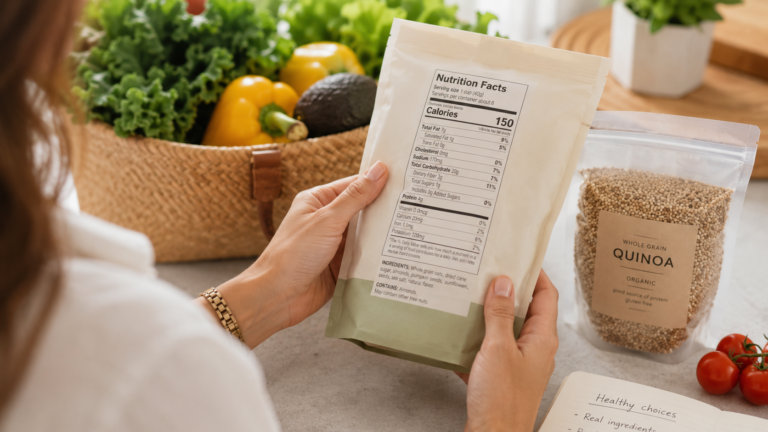
Serving size is the single most important line on a nutrition facts label, and the one people most often skip. Every other number on the label is based on one serving, not the whole package.
A bag of chips might list 150 calories. Reasonable enough, until you notice the serving size is “about 12 chips” and the bag holds three servings. Eat the bag, and you’ve actually had 450 calories.
So before reading anything else, ask two questions:
• How big is one serving?
• How many servings am I really eating?
Then multiply accordingly.
How Should You Read Calories on a Food Label?
Calories Are the Energy Headline
Calories measure how much energy one serving provides. They aren’t inherently “good” or “bad.” What matters is your overall intake across the day and where those calories come from.
Two hundred calories from a food rich in protein and fiber affects your body very differently from 200 calories of pure sugar.
Always read the calorie count alongside the nutrients below it, never in isolation.
Which Nutrients Should You Limit on a Nutrition Label?
Nutrients to Get Less Of
These are the nutrients most people already consume in excess, especially through packaged foods:
• Saturated fat: Linked to raised cholesterol when eaten in large amounts.
• Trans fat: The one fat with essentially no safe level. Aim for zero, and check the ingredients for “partially hydrogenated oils,” which can hide small amounts even when the label reads 0 g.
• Sodium: Most of us get far more than we need, largely from packaged and restaurant food.
• Added sugars: Sugars introduced during processing, listed separately from sugars that occur naturally in fruit or milk.
That “added sugars” line is there for a reason. A fruit yogurt and a soda might show similar total sugar, but the added sugar figure reveals how much was added during processing versus how much came naturally from the ingredients.
Down the right side of most nutrition labels is a column of percentages called the % Daily Value, or %DV. This shows how much one serving contributes to a typical daily diet.
Which Nutrients Should You Look for More Of?
Nutrients to Get More Of
These tend to be under-consumed and can make a packaged food more nourishing:
• Dietary fiber: Supports digestion and helps you feel full.
• Protein: Important for muscle maintenance and satiety.
• Vitamins and minerals: Such as vitamin D, calcium, iron, and potassium.
When you’re comparing two similar products, these nutrients can help you choose the one that supports your body better.
What Does % Daily Value Mean on a Nutrition Label?
The 5% and 20% Daily Value Rule
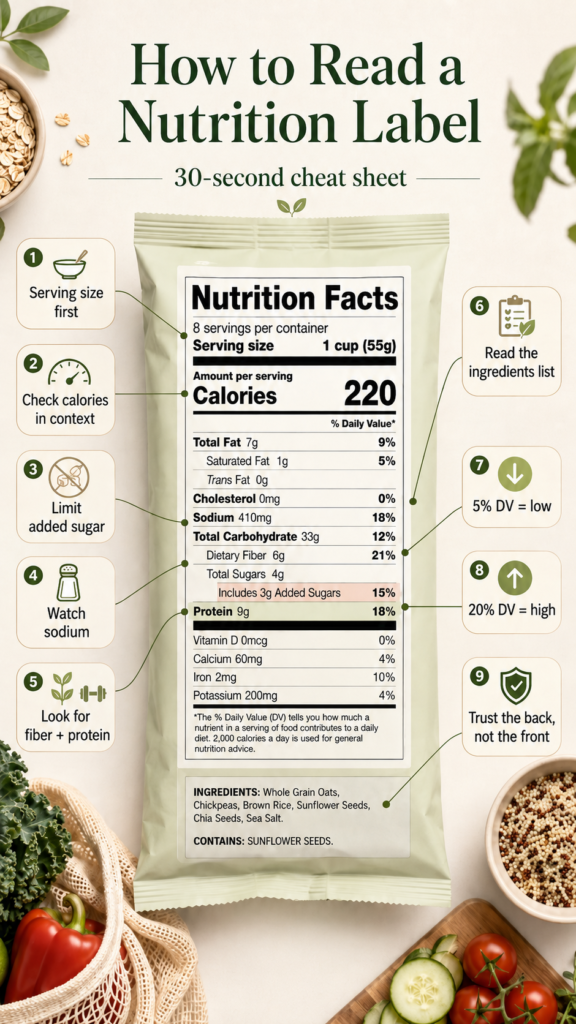
Down the right side of most nutrition labels is a column of percentages called the % Daily Value, or %DV. This shows how much one serving contributes to a typical daily diet.
There’s a simple rule worth memorizing:
• 5% DV or less is low in that nutrient.
• 20% DV or more is high in that nutrient.
Use it for fast comparisons.
Want less sodium? Look for a low %DV.
Want more fiber? Aim high.
No math required.
Just remember that % Daily Value is based on a general reference, commonly a 2,000-calorie diet, so your own needs may differ. Treat it as a guide, not a verdict.
Why Is the Ingredients List Important?
The Nutrition Panel Tells You How Much. The Ingredients List Tells You What.
The nutrition panel tells you how much of each nutrient is present.
The ingredients list tells you what the food is actually made from.
The two together give the full story, and the ingredients list is where the real detail hides.
Ingredients are ranked by weight. The list runs from most to least, so the first ingredient is the main one. Spotting sugar, refined flour, or certain oils near the top tells you a lot right away.
How Does Sugar Hide in Packaged Foods?
Sugar Has Many Names
Sugar wears disguises.
Cane syrup, dextrose, maltose, fruit juice concentrate, high fructose corn syrup, and evaporated cane juice are all forms of sugar.
Manufacturers sometimes split sweeteners across several names so no single one climbs to the top of the ingredients list, even when the total added sugar adds up to a great deal.
This is why it helps to read both the added sugar line and the ingredient list together.
Are Additives and Preservatives Always Bad?
Understanding Additives, Preservatives and Stabilizers
Most packaged foods contain ingredients that aren’t food in the everyday sense. They’re there to extend shelf life, stabilize texture, or boost color and flavor.
Common categories include:
• Preservatives: Such as sodium benzoate, potassium sorbate, sulfites, and BHA/BHT, which slow spoilage and microbial growth.
• Emulsifiers and stabilizers: Such as lecithin, carrageenan, and various gums, which keep ingredients from separating.
• Artificial colors and flavors: Often listed simply as “artificial flavor” or by color names and numbers.
• Flavor enhancers: Such as monosodium glutamate, or MSG.
Not all additives are harmful, and many are well studied and considered safe in normal amounts. Ascorbic acid, for instance, is simply vitamin C.
So a long, unfamiliar ingredients list isn’t proof that something is bad for you. What it usually means is that you’re holding a more heavily processed product.
As a general principle, a shorter list built from things you’d recognize in your own kitchen points to less processing.
Should You Trust Front-of-Pack Claims?
Trust the Back, Not the Front
The front is marketing.
The back is information.
Some front-of-package terms can sound healthier than they really are.
“Made with real fruit” can mean a trace.
“Multigrain” simply means more than one grain.
“Natural” does not automatically mean nourishing or balanced.
None of these claims necessarily mean the product is healthier.
Others are regulated but can still be misleading. “Lite” or “light,” for example, may mean a meaningful reduction in fat, calories, or sodium. But that reduction is measured against the regular version of the same product, which you may never compare it with.
And “low fat” products are often loaded with extra sugar to compensate for flavor.
The lesson is the same either way: when a front-of-package claim catches your eye, flip the package over and let the nutrition label confirm or question it.
How to Read a Nutrition Label in 30 Seconds
The Quick Nutrition Label Checklist
• Serving size first, always. Every number depends on it. Check how many servings you’re actually eating, and multiply.
• Read calories in context, never alone. Pair them with the nutrient breakdown.
• Aim low on sodium, saturated fat, trans fat, and added sugars.
• Aim high on fiber, protein, vitamins, and minerals.
• Use the 5% and 20% Daily Value rule for quick comparisons. Low is 5% or less. High is 20% or more.
• Read the ingredients list, not just the nutrition panel. Ingredients are ranked by weight, and sugar often hides under multiple names.
• Know your additives. Most are safe in normal amounts, but a long, unfamiliar list usually points to a more processed product.
• Trust the back, not the front. Marketing claims belong to the manufacturer. The label belongs to you.
Do this a handful of times and it becomes automatic. A 30-second pass can help you spot inflated serving sizes, hidden sugars, high sodium, and health-halo buzzwords instantly.
The label was never meant to be ignored.
It just needed a translator.
Now you are one.

FAQ
What is the most important thing to check on a nutrition label?
The serving size is the most important thing to check because every number on the nutrition label is based on one serving, not the full package.
What does 5% and 20% Daily Value mean?
A 5% Daily Value or less means the food is low in that nutrient. A 20% Daily Value or more means it is high in that nutrient.
How do you know if a packaged food has too much sugar?
Check both the “added sugars” line and the ingredients list. Sugar may appear under names like cane syrup, dextrose, maltose, fruit juice concentrate, or high fructose corn syrup.
Are preservatives and additives always unhealthy?
No. Many additives are considered safe in normal amounts. But a long, unfamiliar ingredients list usually indicates that the food is more heavily processed.
Should you trust claims like natural, multigrain, or made with real fruit?
Not on their own. These claims can be misleading, so it’s better to check the nutrition label and ingredients list before deciding.