
If you’ve spent any time in the health and wellness corners of the internet lately, you’ve probably seen the warnings.
Seed oils are called “toxic sludge,” the “hateful eight,” and the hidden villain behind everything from obesity to inflammation to heart disease.
Meanwhile, your doctor and most dietitians will tell you these same oils are perfectly fine, and in some cases, even useful as part of a balanced diet.
So who’s right?
Let’s cut through the noise.
What Are Seed Oils?
Seed oils are cooking oils extracted from the seeds of plants.
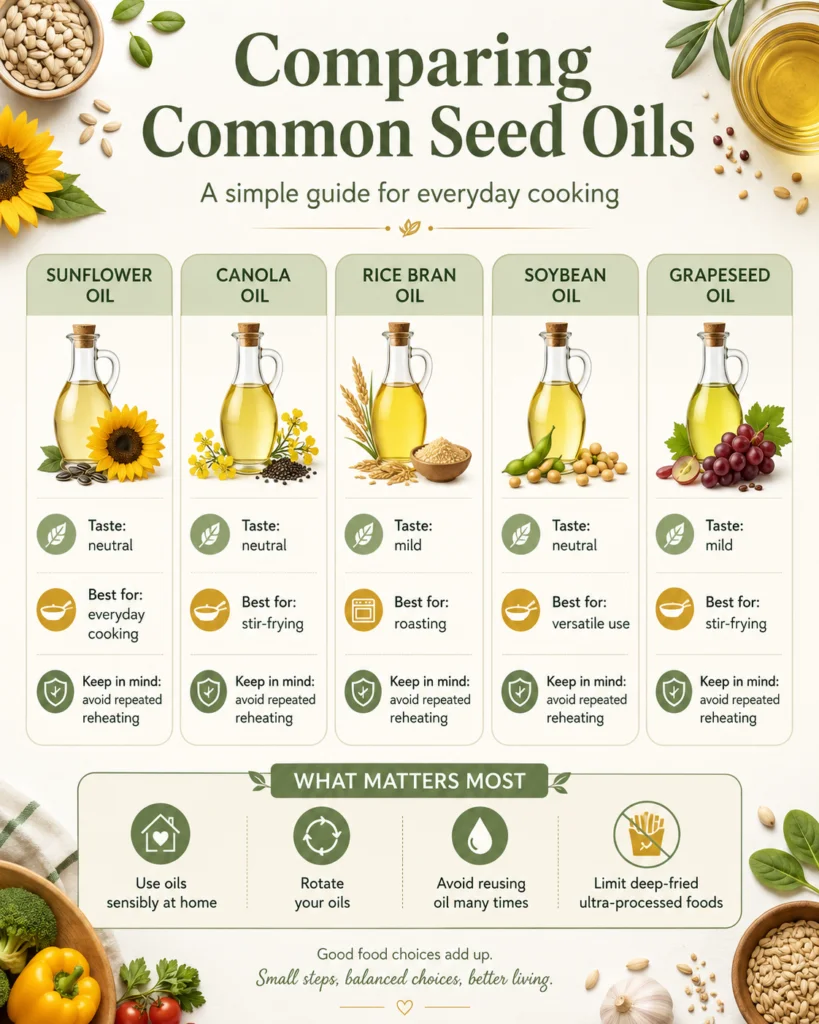
The ones usually named in the debate are:
- Sunflower oil
- Soybean oil
- Corn oil
- Canola oil, also called rapeseed oil
- Safflower oil
- Cottonseed oil
- Grapeseed oil
- Rice bran oil
What they have in common is that they are usually high in polyunsaturated fats, especially an omega-6 fatty acid called linoleic acid.
They became kitchen staples over the last 60 to 70 years largely because they are affordable, neutral-tasting, and were promoted as heart-healthier alternatives to butter, ghee, and lard.

Why Are People Worried About Seed Oils?
Critics of seed oils usually make three main arguments.
1. The Omega-6 Inflammation Argument
The first concern is about omega-6 fats.
Linoleic acid, the main omega-6 fat in many seed oils, can be converted in the body into compounds involved in inflammation.
Because modern diets often contain more omega-6 fats and fewer omega-3 fats than traditional diets, the argument is that this imbalance may drive chronic inflammation.
It sounds convincing.
But the human evidence is more nuanced.
Systematic reviews of randomized controlled trials have not found strong evidence that higher linoleic acid intake meaningfully raises inflammatory markers in healthy adults.
So while omega-6 and omega-3 balance matters, the idea that seed oils automatically “cause inflammation” is too simplistic.
2. The Processing Argument
Most commercial seed oils are extracted and refined through industrial processing. This may involve heat, solvents, bleaching, and deodorizing.
Critics argue that this processing strips away beneficial compounds and may create harmful byproducts.
There is some truth here. Refined oils are more processed than cold-pressed oils, and refining can reduce some naturally occurring antioxidants.
But “processed” does not automatically mean poisonous.
If you prefer less processed options, cold-pressed oils can be a good choice. But a refined oil used sensibly at home is not the same thing as eating deep-fried ultra-processed food every day.
3. The Oxidation Argument
This is the criticism with the most practical relevance.
Polyunsaturated fats are more chemically fragile than saturated fats. When repeatedly heated to high temperatures, especially in commercial deep fryers, oils can break down and form compounds such as aldehydes. Research on heated cooking oils shows that high-temperature frying, long heating time, and repeated use can increase these oxidation products.
But notice what this is really an argument against.
It is not an argument against one teaspoon of sunflower oil in your home-cooked sabzi.
It is an argument against frequently eating deep-fried food made in repeatedly reheated oil.
That advice applies no matter which oil is in the fryer.
What Does the Science Say About Seed Oils and Inflammation?
The claim that seed oils are inflammatory is one of the most common claims online.
But in human studies, higher intake of linoleic acid does not consistently increase common inflammatory markers. A systematic review of randomized controlled trials found little evidence that dietary linoleic acid increases inflammation in healthy people.
This does not mean everyone needs to eat more seed oils.
It simply means the “seed oils equal inflammation” claim is not strongly supported by human evidence.
The bigger picture matters more: total diet quality, omega-3 intake, processed food intake, cooking method, and how often the oil is overheated or reused.
Seed oils are not magic. But they are also not the villain they are made out to be.
Are Seed Oils Bad for Heart Health?
This is where the internet narrative often clashes with mainstream nutrition guidance.
Many heart-health recommendations encourage replacing saturated fats with unsaturated fats, including polyunsaturated fats from plant oils. The American Heart Association advises limiting saturated and trans fats and using nontropical plant oils as part of heart-healthy eating patterns.
This does not mean you should pour seed oils over everything.
It means that replacing large amounts of butter, ghee, lard, or other saturated fats with unsaturated oils may support better cardiovascular risk markers for many people.
The nuance is important.
Seed oils are not magic.
But they are also not the villain they are made out to be.
Why Do People Feel Better When They Quit Seed Oils?
Plenty of people say they feel healthier, lose weight, or have better digestion after cutting out seed oils.
That may be true.
But the reason may not be the oil itself.
Look at where seed oils often live in the modern diet: chips, fried chicken, instant noodles, biscuits, namkeen, packaged snacks, fast food, and takeaway meals.
When someone eliminates seed oils, they often eliminate a large portion of ultra-processed and deep-fried foods at the same time.
Of course they feel better.
But the credit likely goes to reducing fried and ultra-processed foods, not to removing seed oils alone.
A samosa fried in ghee is not suddenly a health food.
Did Seed Oils Cause the Rise in Obesity and Chronic Disease?
Seed oil critics often point out that seed oil consumption rose during the same decades as obesity, diabetes, and chronic disease.
That is true.
But many other things changed at the same time too.
People started eating more total calories, more refined carbohydrates, more sugar, more ultra-processed foods, and more restaurant food. Physical activity reduced. Screen time increased. Sleep patterns changed.
Pinning the blame on one ingredient in that entire lifestyle shift is storytelling, not science.
Nutrition rarely works that neatly.
Should You Avoid Seed Oils Completely?
For most people, there is no need to completely avoid seed oils.
A more practical approach is:
- Use cooking oils sensibly at home
- Avoid repeatedly reheating any oil
- Limit deep-fried and ultra-processed foods
- Rotate oils instead of depending on only one
- Include omega-3 sources regularly
- Focus on whole foods more than oil fear
If you personally feel better using cold-pressed oils, olive oil, ghee, or coconut oil in moderation, that is completely fine.
But fear is not required.
Which Oils Should You Use for Cooking?
No single oil is perfect.
A flexible oil rotation can work well:
- Use sunflower, canola, rice bran, groundnut, or mustard oil for everyday Indian cooking, depending on taste and tolerance
- Use extra virgin olive oil for salads, dips, and low-heat cooking
- Use ghee or coconut oil in small amounts where the flavour matters
- Avoid heating any oil until it smokes
- Do not reuse frying oil multiple times
This gives you a wider spread of fatty acids without turning cooking into a fear-based decision.
What Is the Real Problem With Seed Oils?
The real problem is usually not the bottle of oil in your kitchen.
It is the larger dietary pattern around it.
The bigger concern is seed oils inside ultra-processed foods: chips, biscuits, fried snacks, fast food, instant noodles, and packaged foods built around refined flour, salt, sugar, flavouring, and cheap fat.
The oil becomes part of a much bigger problem.
So instead of asking, “Is sunflower oil toxic?” ask:
“Am I eating mostly home-cooked food, or mostly packaged and fried food?”
That question gets you much closer to the truth.
Practical Takeaways
- Don’t fear the bottle. Seed oils used sensibly at home are not the main issue.
- Avoid repeatedly reheated oil, especially from commercial deep frying.
- Limit ultra-processed and deep-fried foods. That solves most of the real concern.
- Rotate your oils instead of relying on only one.
- Get enough omega-3s from fatty fish, flaxseeds, chia seeds, walnuts, or supplements if recommended.
- Don’t let the internet turn one ingredient into the villain for an entire lifestyle pattern.
The Verdict: Mostly Panic, With a Small Real Problem
The seed oil scare is a classic case of a small kernel of truth being inflated into a grand toxic narrative.
Yes, oils can oxidize when repeatedly heated at high temperatures.
Yes, seed oils are common in ultra-processed and fried foods.
But that does not mean a seed oil used sensibly in home cooking is toxic.
The strongest practical advice is still the least dramatic: eat mostly whole foods, limit deep-fried and ultra-processed foods, rotate your oils, and don’t reuse overheated oil.
Nutrition rarely offers villains as convenient as a single bottle on your shelf.
The boring truth remains undefeated.

FAQs
Are seed oils bad for you?
Seed oils are not automatically bad for you. Used sensibly in home cooking, they can fit into a balanced diet. The bigger concern is frequent intake of deep-fried and ultra-processed foods that contain repeatedly heated oils.
Do seed oils cause inflammation?
Current human evidence does not strongly support the claim that linoleic acid from seed oils increases inflammatory markers in healthy adults. The relationship between fats, inflammation, and overall diet quality is more nuanced.
Which oils are considered seed oils?
Common seed oils include sunflower oil, soybean oil, corn oil, canola oil, safflower oil, cottonseed oil, grapeseed oil, and rice bran oil.
Is sunflower oil bad for health?
Sunflower oil is not inherently bad for health. The concern depends on how much you use, how often it is heated, whether it is reused, and what the rest of your diet looks like.
Is canola oil bad for you?
Canola oil is a plant-based oil high in unsaturated fats. It is not inherently harmful when used appropriately, though people who prefer less processed oils may choose cold-pressed alternatives.
What is the healthiest oil for Indian cooking?
There is no single healthiest oil for everyone. A rotation of oils such as mustard, groundnut, rice bran, sunflower, sesame, olive oil, and small amounts of ghee can work well depending on cooking method, taste, health goals, and tolerance.
Should I stop eating seed oils completely?
Most people do not need to stop eating seed oils completely. It is more useful to reduce deep-fried foods, packaged snacks, and repeatedly reheated oils than to fear small amounts of oil used in home cooking.