
Every packet in your kitchen has a story, and most of us were never taught to read it.
You pick up a product. The front says natural. High protein. No added sugar. Clean label.
So you put it in your cart.
Most of us do, because we trust the packaging. Because we don’t always have time to decode a twenty-ingredient list while standing in a supermarket aisle. And honestly, because nobody ever taught us how to read food labels properly.
That changes today.
Reading a food label is one of the most useful skills you can have as a shopper. It doesn’t matter where you live or which supermarket you use. Once you know what to look for, the front of the box loses its power over you.
This is a simple walkthrough of how to read food labels, what to check in the ingredient list, which ingredients are worth a second look, and the three-question checklist you can use in any aisle, anywhere.
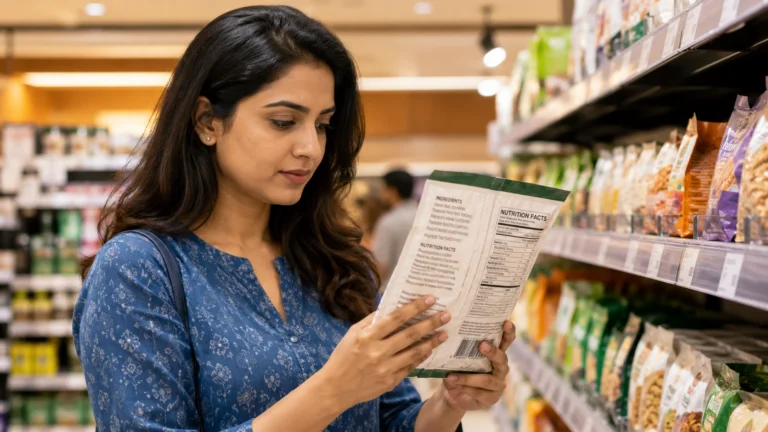
Why Food Labels Feel So Confusing
Food labels can feel confusing because they combine marketing claims, nutrition facts, serving sizes, ingredients, additives, preservatives, and technical names all in one small space.
The front of the packet is designed to make you feel something. The back of the packet is where the actual information lives.
That’s why the first step is simple: turn the packet over.
The First Rule: The Front Is Marketing
The front of the packet is designed to sell.
Some of its favourite words are barely regulated. “Natural,” for instance, has no formal legal definition in many places, and phrases like “wholesome” or “made with real ingredients” are often chosen to make you feel good rather than to tell you much.
That said, not every front-of-pack term is a free-for-all. Claims like “no added sugar,” “sugar free,” and “light” are legally defined and enforceable in many countries. A product can’t use them without meeting specific criteria.
The catch is that a regulated claim can still be misleading in spirit.
A juice labelled “no added sugar” can still be high in natural sugar. A “light” product only has to be lighter than its own regular version, which you may never compare it with on the shelf.
So the rule isn’t “the front is always lying.”
It’s simpler than that.
The front tells you what the brand wants you to notice. The ingredient list tells you what is actually in there.
Always turn the packet over.
How to Read the Ingredient List
The ingredient list is one of the most important parts of a food label because it tells you what the product is actually made from.
A nutrition label tells you the numbers.
An ingredient list tells you the story.
This is where you can understand whether a product is mostly whole food, mostly sweeteners, mostly refined starches, or heavily processed with additives and flavouring agents.
One honest caveat, though: a long or unfamiliar-sounding name isn’t automatically harmful.
Length Is a Clue
A minimally processed product usually has a short ingredient list, often one you can read out loud without stumbling.
If you’re looking at eighteen, twenty, or twenty-five ingredients, that’s usually a signal that you’re holding something more processed, with more additives and more distance from whole food.
That’s worth knowing.
One honest caveat, though: a long or unfamiliar-sounding name isn’t automatically harmful.
Plenty of chemical-sounding ingredients are benign. Ascorbic acid is vitamin C. Tocopherol is vitamin E. Many additives are well studied and considered safe in normal amounts.
So treat length as a marker of processing, not proof of danger.
Shorter and more recognisable tends to mean less processed. That’s the useful takeaway.
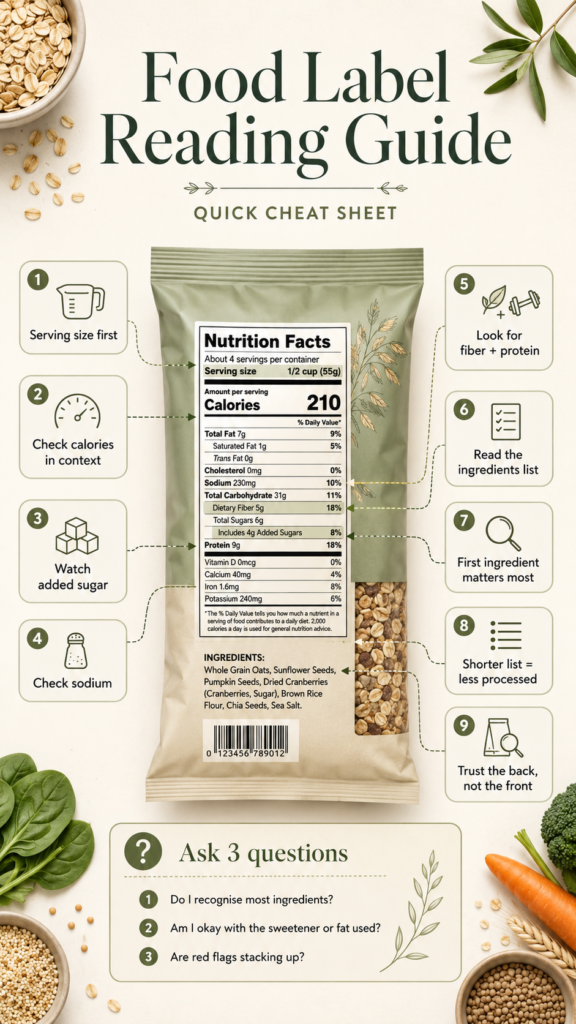
The First Ingredient Matters Most
Ingredients are listed in descending order by weight. Whatever appears first is what the product contains the most of.
This one rule alone can change how you shop.
If you pick up a nut butter and the first ingredient isn’t the nut, pause.
If a “health” bar lists a sweetener before oats, nuts, or dates, the sweetener is one of the dominant ingredients, no matter what the front claims.
Always read from the top.
Ingredients Worth a Closer Look
Think of these less as a banned list and more as prompts to slow down and check what you’re actually buying.
Maltodextrin
Maltodextrin is a highly processed starch usually made from corn, wheat, rice, or potato. It is often used as a cheap filler, thickener, or texturiser.
It also has a high glycemic index, which means it can raise blood sugar quickly in some people.
That makes it worth noticing in protein powders, health bars, meal replacements, breakfast cereals, and products marketed as “healthy.”
It doesn’t mean you need to panic. It means you should know it’s there.
Added Sugar Under Different Names
Sugar wears many names on food labels.
Glucose syrup, dextrose, cane juice, raw sugar, high fructose corn syrup, maltose, fruit juice concentrate, and evaporated cane juice are all forms of sugar.
If several sweet-sounding names are scattered through one ingredient list, treat it as a higher-sugar product regardless of what the front label says.
The “added sugars” line on the nutrition panel helps here too. But the ingredient list gives you the full picture.
Artificial Sweeteners
Artificial sweeteners such as sucralose, aspartame, acesulfame K, saccharin, and neotame often appear in “sugar free,” “zero,” and “diet” products.
The evidence on them is mixed rather than completely settled.
Many regulators consider approved sweeteners safe within acceptable daily intake limits, but some health bodies and studies have raised questions about relying on non-sugar sweeteners for long-term weight control, appetite, and gut health.
A reasonable takeaway is this: they are not the villain some make them out to be, but “zero calorie” does not mean “zero to think about.”
What About Stevia and Monk Fruit?
Stevia and monk fruit are plant-derived sweeteners, which many people prefer.
But “natural” does not automatically mean better for everyone. They can still affect taste preferences, cravings, and gut response differently from person to person.
Use them if they suit you. Just remember that amount still matters.
Highly Refined Oils
Refined oils often show up in biscuits, spreads, chocolates, chips, cereals, and children’s packaged foods.
Here, it helps to separate two ideas.
Choosing cold-pressed oils, ghee, or less added oil overall can be a valid personal preference. But the popular claim that all seed oils are automatically inflammatory is too simplistic.
The bigger concern with oils is usually context: how much is being used, how processed the overall food is, and whether the oil has been repeatedly heated at high temperatures.
So instead of fearing every oil name, look at the whole product.
Is it a simple food with a small amount of oil? Or is it a highly processed snack built around refined flour, sugar, flavouring, and cheap fat?
That distinction matters more.
Artificial Colours
On Indian food labels, artificial colours may appear as permitted synthetic food colours or E numbers, especially in the 100s.
On imported products, you may see names like Red 40, Yellow 5, Yellow 6, or Blue 1.
Colour is purely cosmetic. A mango product should ideally be yellow because of mango, not because of added colour.
If a product has multiple artificial colours, especially when it is meant for children, it is fair to skip it.
Artificial Versus Natural Flavour
“Artificial flavour” usually means a synthetic flavouring blend.
A cleaner product tends to name its actual sources, such as vanilla extract, real cocoa, cinnamon, cardamom, or fruit powder, rather than simply saying “flavour.”
This does not mean every flavouring agent is harmful. It just means the label is less transparent.
When the real ingredient is present, brands usually say so clearly.
Preservatives Worth Knowing
Preservatives are added to extend shelf life and prevent spoilage. Some common names include sodium benzoate, potassium sorbate, BHA, BHT, and TBHQ.
Not all preservatives are automatically harmful. Many are used in small amounts and are considered safe within approved limits.
But when a product contains preservatives along with artificial colours, artificial flavours, refined starches, sweeteners, and a long list of additives, it’s a sign that the product is more heavily processed.
Seeing tocopherol, which is vitamin E, used as a preservative can be a small green flag.
A Few Contested Ingredients
Some ingredients attract a lot of concern online, including carrageenan, silicon dioxide, and phosphoric acid.
In many cases, these ingredients are permitted by major food regulators and are not something to panic over individually.
But they are worth noticing when they appear alongside multiple colours, flavours, sweeteners, and additives in the same product.
The goal is not fear.
The goal is pattern recognition.
One additive in an otherwise simple food is very different from a long list of additives in a product pretending to be healthy.
The Three-Question Food Label Checklist
Before buying any packaged food, ask yourself three questions:
1. Can I Recognise Most of the Ingredients?
You don’t need to recognise every single ingredient. But most of the list should feel understandable.
Look for real foods, familiar pantry ingredients, or known safe additives.
2. Am I Comfortable With the Sweetener or Fat Used?
Check what is doing the sweetening and what is providing the fat.
Is the sweetness coming mostly from dates, fruit, jaggery, sugar, syrup, artificial sweeteners, or a mix of many sweeteners?
Is the fat coming from nuts, seeds, ghee, butter, cold-pressed oil, refined oil, or hydrogenated fat?
You don’t need a perfect answer. You just need an informed one.
3. Are Red Flags Stacking Up?
One preservative is not the same as a long list of preservatives, colours, artificial flavours, sweeteners, refined oils, and fillers.
When red flags stack up, the product is usually more processed than it looks.
That does not mean you can never eat it. It simply means you should know what you are choosing.
Practical Takeaways
• Flip the packet first. The back is where the real information lives.
• Shorter usually means less processed, but treat length as a processing signal, not proof of harm.
• The first ingredient is the most important. It tells you what the product actually contains the most of.
• Sugar has many names. Learn to spot them.
• “Zero calorie” is not “zero to think about.”
• Additives are not always harmful, but too many additives can signal a highly processed product.
• You don’t need to be perfect. You need to be informed.
The Bottom Line
Learning how to read food labels takes less than two minutes, and it shifts the power back to you.
The front of the packet is a story a brand wants you to believe. The ingredient list is closer to the truth.
Once you can read it, you shop with a clarity no marketing campaign can touch.
Your body deserves to know what it’s being fed, and you deserve to choose with full information rather than a front-of-pack promise.
Start with one product today. Flip it over. Read it slowly. Ask the three questions.
That’s where it begins.
FAQs
What should I check first when reading a food label?
Start with the ingredient list. The front of the packet is marketing, while the ingredient list tells you what the product is actually made from.
What does the first ingredient on a food label mean?
The first ingredient is the ingredient present in the highest amount by weight. This helps you understand what the product mainly contains.
Is a long ingredient list always bad?
No. A long ingredient list is not automatically bad, but it usually suggests the product is more processed. Treat it as a clue, not proof of harm.
What are some hidden names for sugar on food labels?
Sugar may appear as glucose syrup, dextrose, maltose, cane juice, fruit juice concentrate, high fructose corn syrup, raw sugar, or evaporated cane juice.
Is maltodextrin bad for you?
Maltodextrin is not automatically harmful, but it is highly processed and can raise blood sugar quickly in some people. It is worth noticing in health bars, protein powders, and meal replacements.
Are artificial sweeteners safe?
Approved artificial sweeteners are considered safe within regulated intake limits, but the evidence around long-term use, appetite, gut health, and weight management is mixed. It is best to use them mindfully rather than assuming “zero calorie” means no concern.
Are all food additives harmful?
No. Many food additives are considered safe in normal amounts. The concern is usually when a product has many additives, artificial colours, flavours, sweeteners, and preservatives together.