Let’s start with something important.
The biological clock is real.
As women age, both egg quantity and egg quality naturally decline. We do not help women by pretending otherwise. Age absolutely influences fertility, and it is one of the reasons women deserve to understand their reproductive timeline instead of assuming they will simply “figure it out later.”
But here is what I find fascinating.
Two women can be the exact same age and have completely different fertility journeys.
One woman may conceive naturally and relatively easily, while another may struggle with ovulation, implantation, recurrent pregnancy loss or poor embryo quality.
If age were the only factor that mattered, that would not happen.
The truth is that your eggs do not exist in isolation. They live inside your body, and they are constantly being influenced by the environment around them. Every meal you eat, every night of sleep you miss, every inflammatory trigger your body encounters and every nutrient deficiency you carry has the potential to shape that environment.
In many ways, egg quality is a reflection of overall health.
What Egg Quality Really Reflects
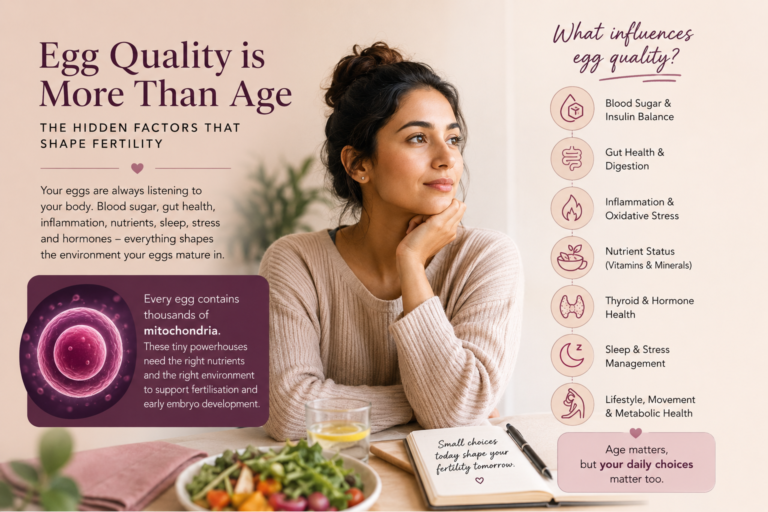
Egg quality is not only about age. It is also influenced by blood sugar balance, insulin sensitivity, gut health, inflammation levels, nutrient stores, thyroid function, sleep, stress and overall hormone health.
Your body does not separate fertility from the rest of your health. Your ovaries are listening to your metabolism, digestion, immune system, nutrient status and nervous system every single day.
This is why fertility nutrition matters. It is not about one “fertility food” or one supplement. It is about supporting the body your eggs are maturing inside.
Mitochondria and Egg Quality
One of the reasons egg quality is so closely connected to overall health lies inside the egg itself.
Every egg contains thousands of mitochondria, tiny energy-producing structures that power fertilisation and early embryo development. These mitochondria are sensitive to oxidative stress, inflammation and nutrient deficiencies.
When mitochondria are functioning well, they help support healthy egg maturation. When they are not, the effects can ripple throughout the fertility journey.
This is why supporting egg quality often begins with the foundations: steady blood sugar, enough nutrients, good sleep, lower inflammation and a healthier lifestyle rhythm.
Blood Sugar, Insulin Resistance and Fertility
This is where blood sugar enters the conversation.
Most women associate blood sugar problems only with diabetes, but insulin is also deeply connected to reproductive health.
Insulin is not just a metabolic hormone. It also influences the ovaries. Your ovaries have insulin receptors and respond to metabolic signals every day. When insulin resistance develops, the body needs to produce more insulin to manage blood sugar. Over time, this can affect ovulation, androgen levels and hormone balance.
This is especially common in women with PCOS, but it can also happen in women who do not have a formal PCOS diagnosis.
Insulin resistance may show up as intense sugar cravings, fatigue after meals, stubborn belly fat, difficulty losing weight, acne, increased facial hair, irregular periods, energy crashes, worsening PMS or brain fog.
These signs often appear long before blood sugar levels become abnormal on routine tests.
This is why insulin resistance and fertility need to be discussed together. If your blood sugar is unstable, your ovaries receive that signal too.
Improving blood sugar balance through protein-rich meals, fibre, strength training, better sleep and consistent eating patterns can be one of the most powerful foundations for hormone health, ovulation and egg quality.
Gut Health and Egg Quality
Metabolic health does not stop with blood sugar.
The gut is another piece of the fertility puzzle that rarely gets the attention it deserves. Most women do not connect bloating, constipation, acidity or digestive discomfort with egg quality, yet the gut plays a central role in regulating inflammation, supporting immune function and absorbing nutrients required for reproductive health.
After all, nutrients like iron, zinc, selenium, omega-3 fats, choline and B vitamins cannot support fertility if they are not being properly absorbed in the first place.
A woman may be eating well, taking supplements and trying to optimise fertility, but if digestion and absorption are compromised, the body may still struggle to receive what it needs.
At Nutrition In Sync, we often say that you cannot separate gut health from hormone health, and fertility is no exception.
Inflammation, Endometriosis and Thyroid Health
Then there is inflammation.
Not the kind that lands you in hospital, but the low-grade chronic inflammation that quietly accompanies insulin resistance, poor sleep, chronic stress, endometriosis, autoimmune conditions and ultra-processed diets.
This type of inflammation increases oxidative stress throughout the body. And unfortunately, developing eggs are not protected from that environment.
Women with endometriosis often understand this better than anyone. Endometriosis is not simply a reproductive condition; it is also an inflammatory condition. It can affect the pelvic environment, immune response and fertility journey in complex ways.
The same can be said for autoimmune conditions like Hashimoto’s, where chronic immune activation can create challenges that extend far beyond the thyroid gland.
This is why fertility support cannot only focus on the ovaries. It also needs to consider inflammation, thyroid function, gut health, blood sugar balance and the body’s overall resilience.
We often see women with depleted iron stores, inadequate vitamin D levels, poor omega-3 status or insufficient choline intake who are doing everything possible to optimise fertility while unknowingly missing some of the foundations.
Nutrient Deficiencies That Can Affect Fertility
Nutrient status matters deeply when discussing fertility and preconception health.
Many women begin thinking about nutrition only once they are actively trying to conceive. But fertility is not a three-month project. It is the culmination of years of nutritional inputs, stress patterns, sleep quality, movement, deficiencies and lifestyle habits.
We often see women with depleted iron stores, inadequate vitamin D levels, poor omega-3 status or insufficient choline intake who are doing everything possible to optimise fertility while unknowingly missing some of the foundations.
Iron is particularly important because of its role in oxygen delivery and mitochondrial energy production. If the tiny power plants inside the egg require energy to function, they also require the raw materials that make energy production possible.
Other nutrients like zinc, selenium, B vitamins, omega-3 fats and choline also play important roles in hormone health, thyroid support, inflammation regulation and reproductive health.
This does not mean every woman should take every supplement. It means fertility nutrition should be personal, guided and rooted in what your body actually needs.

Why Preconception Health Starts Months Before Pregnancy
Perhaps the most empowering thing to understand is that fertility begins long before conception.
The egg you ovulate this month did not begin developing this month. Its journey started roughly three to four months ago.
That means the sleep you are getting tonight, the protein you are eating today, the muscle you are building in the gym, the blood sugar balance you are creating and the inflammation you are addressing may all influence the eggs you ovulate months from now.
You cannot change your age. You cannot change the number of eggs you were born with. But you can support the environment your eggs mature in.
That support may look like balancing blood sugar, supporting gut health, correcting nutrient deficiencies, addressing inflammation, managing thyroid health, sleeping consistently, strength training and reducing ultra-processed foods.
These are not quick fixes. They are foundations.
Fertility Is More Than a Countdown
Which brings us back to where we started.
Yes, the biological clock is real.
But fertility is far more than a countdown.
Your eggs are listening to everything.
They are listening to your blood sugar, your gut health, your nutrient stores, your inflammation levels, your thyroid function, your sleep and your stress.
Age may determine how much time you have.
But the environment surrounding your eggs helps determine how well that time is used.
At Nutrition In Sync, our ONE Program helps women understand these root connections through personalised nutrition, bloodwork insights and hormone-smart lifestyle support, so fertility is supported as part of the whole body, not treated as one isolated symptom.
And that is a fertility conversation every woman deserves to hear.
FAQs
Can egg quality be improved naturally?
You cannot change your age or increase the number of eggs you were born with, but you can support the environment in which eggs mature. Blood sugar balance, gut health, inflammation, nutrient status, thyroid function, sleep and stress all play a role in fertility health.
What foods help improve egg quality?
Foods that support egg quality include protein-rich meals, colourful vegetables, omega-3 rich foods, nuts and seeds, iron-rich foods, fibre-rich carbohydrates and foods rich in zinc, selenium, choline and B vitamins. The right plan depends on your symptoms, bloodwork and health history.
Does PCOS affect egg quality?
PCOS can affect fertility by disrupting ovulation, insulin balance, androgen levels and inflammation. Not every woman with PCOS has poor egg quality, but supporting metabolic health can improve the hormonal environment around ovulation.
How does insulin resistance affect fertility?
Insulin resistance can affect ovulation, androgen levels and blood sugar stability. It is commonly seen in women with PCOS but may also occur without PCOS. Improving insulin sensitivity is often an important part of fertility nutrition.
Is gut health connected to fertility?
Yes. Gut health supports nutrient absorption, inflammation regulation, immune function and hormone metabolism. If digestion is poor, the body may struggle to absorb key fertility nutrients like iron, zinc, selenium, omega-3 fats and B vitamins.
How long before trying to conceive should I focus on nutrition?
Ideally, women should begin focusing on fertility nutrition and preconception health at least three to four months before trying to conceive. Egg and follicle development take time, so the body environment you create before conception matters.