
Many women continue to experience fatigue, hair fall, brain fog, cold intolerance and stubborn weight gain despite being told their thyroid levels are normal. In many cases, the missing link is not the thyroid gland itself but low ferritin, the body’s iron storage protein.
Iron is essential for thyroid hormone production, thyroid hormone activation and cellular response to thyroid hormones. Without adequate iron stores and optimal ferritin levels, thyroid medication may not work effectively. Understanding this connection can completely change how persistent thyroid symptoms and hypothyroidism-like symptoms are approached.

What is ferritin, and why your TSH alone is not enough
It is common to see women diagnosed with hypothyroidism or thyroid dysfunction who are started on medication and monitored through TSH levels.
Yet they still feel exhausted.
Their hair continues thinning.
They struggle with workouts.
They feel cold all the time.
Their weight does not shift.
Often the response is to increase the dose.
But sometimes the thyroid is not the core issue. The foundation is.
One of the most overlooked drivers of persistent thyroid symptoms, fatigue and hair loss in women is low ferritin and iron deficiency.
What Is Ferritin
Ferritin reflects stored iron, not just circulating iron in the blood.
Most standard blood panels focus on hemoglobin levels to detect anemia. But ferritin drops much earlier. You can have normal hemoglobin and still have iron deficiency or depleted iron reserves.
Iron is required for:
• Enzyme activity
• Hormone production
• Oxygen delivery to tissues
• Mitochondrial energy production
• Immune balance
Without enough iron, metabolism slows down. And thyroid physiology and thyroid hormone function are directly affected.
Research shows even mild iron deficiency can reduce thyroid hormone production, especially in women’s health and hormonal conditions. This explains why iodine supplementation often does not help when ferritin is low.
How low ferritin disrupts thyroid hormone production
Iron and the TPO enzyme: why thyroid hormone synthesis drops
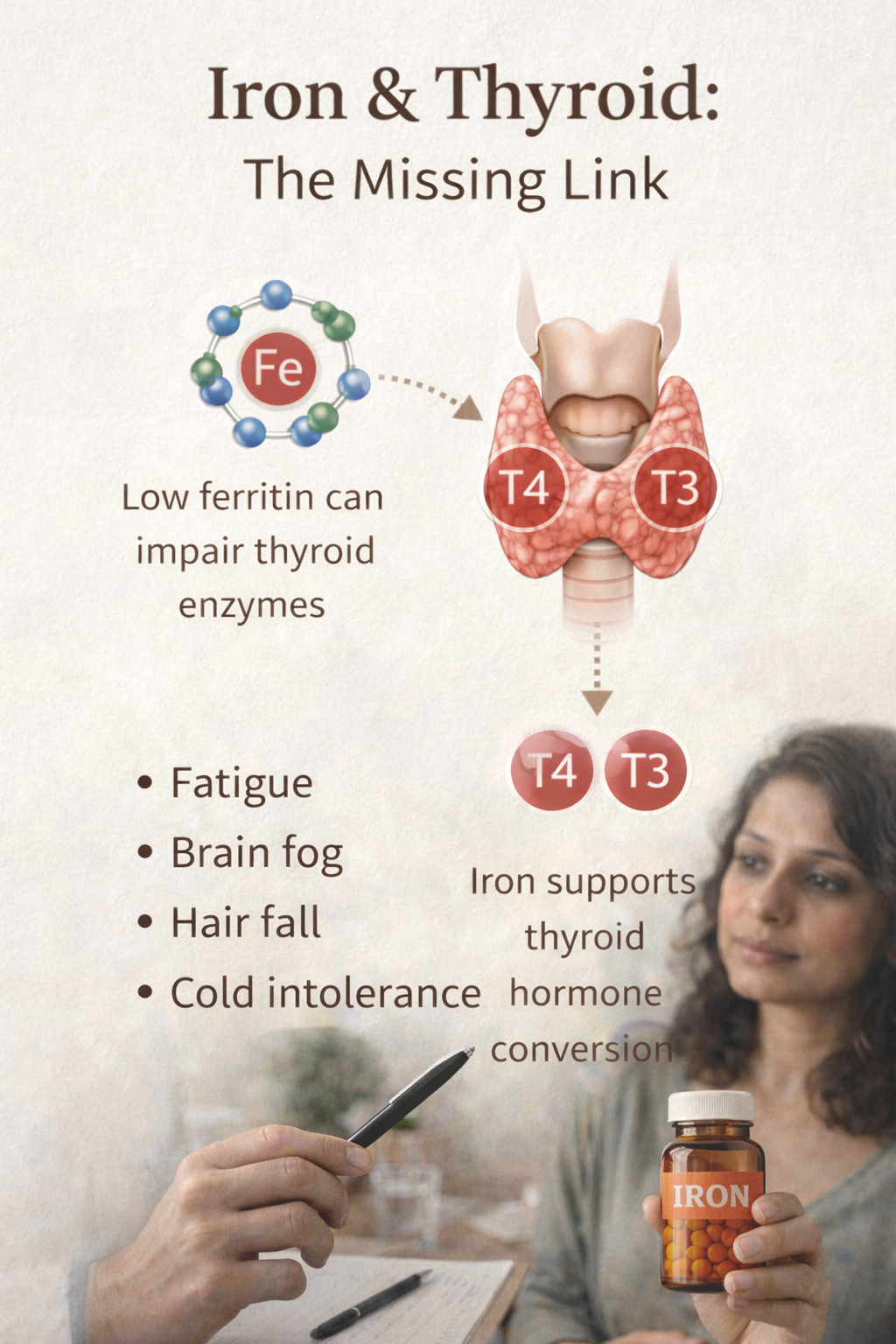
Thyroid hormone production depends on an enzyme called thyroid peroxidase (TPO). This enzyme is iron dependent.
When iron is low:
• Iodine utilization decreases
• Hormone synthesis drops
• T4 and T3 thyroid hormone production reduces
Research shows even mild iron deficiency can reduce thyroid hormone production, especially in women’s health and hormonal conditions. This explains why iodine supplementation often does not help when ferritin is low. The thyroid lacks the raw material required to function efficiently.
Ferritin and T4 to T3 conversion: the hormone activation problem
Iron is also required for deiodinase enzymes, which convert inactive T4 thyroid hormone into active T3 thyroid hormone.
When ferritin levels are low, conversion slows down. A common pattern appears:
• Normal or slightly elevated TSH
• Normal T4
• Low or functionally low T3
Patients feel hypothyroid, yet labs look acceptable.
This is not always medication failure. It is often a nutrient-driven thyroid hormone conversion issue.
Why thyroid medication alone may not resolve symptoms when ferritin is low
Thyroid medication replaces hormone. It does not correct iron deficiency or low ferritin levels.
Low ferritin can:
• Reduce cellular response to thyroid hormone
• Increase fatigue and low energy
• Worsen hair loss and hair thinning
• Slow metabolism and energy production
Increasing thyroid medication when iron is low may cause palpitations, anxiety or poor sleep without resolving core symptoms.
Until iron stores and ferritin levels improve, the body may not fully respond to thyroid therapy.
Why women are more vulnerable to low ferritin than men
Low ferritin and iron deficiency in women is extremely common.
Contributing factors include:
• Heavy menstrual bleeding
• Endometriosis or uterine fibroids
• PCOS related irregular cycles
• Perimenopausal hormonal shifts
• Vegetarian or low heme iron intake
• Poor iron absorption due to gut issues
Studies show iron deficiency is more common in women with hypothyroidism compared to the general population. Many symptomatic women have ferritin levels below 30 ng per mL, even though optimal thyroid support and hormone production often requires higher reserves.

Ferritin and Hashimoto’s
Iron deficiency also influences autoimmune thyroid disease, particularly Hashimoto’s thyroiditis.
Low ferritin contributes to:
• Increased oxidative stress
• Impaired immune regulation
• Reduced antioxidant protection
In Hashimoto’s thyroid disease, low iron is associated with greater fatigue and slower clinical improvement. Iron repletion may also enhance the effectiveness of selenium, an important nutrient in autoimmune thyroid care.
In autoimmune cases, correcting low ferritin levels is often foundational before expecting meaningful improvement.
How to test ferritin correctly, and what ‘optimal’ actually means
TSH alone is not enough for evaluating thyroid health.
The full panel: what to ask your doctor to include
• Ferritin
• Serum iron
• Transferrin saturation or TIBC
• Hemoglobin
• C reactive protein (CRP) to rule out inflammation
Ferritin should always be interpreted alongside inflammatory markers. In functional practice, ferritin is often optimized between 70 and 150 ng per mL depending on the individual.
Iron supplementation should never begin without testing. Excess iron can increase oxidative stress and tissue damage.
How to raise ferritin: food, supplementation, and what to avoid
Improve Iron Intake
Best iron-rich foods: heme versus non-heme sources
Heme iron sources (better absorbed):
• Red meat
• Liver
• Sardines
Non-heme iron sources:
• Pumpkin seeds
• Sesame seeds
• Lentils
• Spinach
How to pair iron foods with vitamin C for better absorption
Pair iron-rich foods with vitamin C to improve absorption. Avoid tea or coffee around iron-containing meals, as they reduce iron absorption.
If ferritin is below 30 ng per mL, diet alone is usually insufficient.
Supplement Carefully
Iron supplements: best forms, timing, and what to avoid taking alongside them
If ferritin is significantly low:
• Use practitioner-guided iron supplementation
• Choose well absorbed forms such as iron bisglycinate
• Separate from thyroid medication by at least four hours
• Reassess ferritin levels in 8 to 12 weeks
Ferritin rises gradually and should be monitored to avoid iron overload.

Key Takeaways
• Normal thyroid labs do not guarantee optimal thyroid function
• Ferritin is essential for thyroid hormone production and activation
• Persistent fatigue, hair loss and hypothyroid symptoms warrant deeper investigation
• Thyroid healing requires restoring foundational nutrients such as iron
Low ferritin can mimic or worsen hypothyroid symptoms including fatigue, hair fall, brain fog and slow metabolism. Thyroid medication cannot override iron deficiency.
True thyroid recovery and hormone balance begins at the cellular level.
If you are still symptomatic despite “normal” thyroid labs, ask a different question:
Have my iron stores and ferritin levels been properly assessed?
Because sometimes, your thyroid is not the real problem.